Why AI feedback makes pronunciation practice different
Most people cannot hear their own pronunciation the way a listener does. Inside your own head, the word you meant to say and the word you actually produced sound identical. That gap is why repeating a word twenty times on your own can leave the same error untouched.
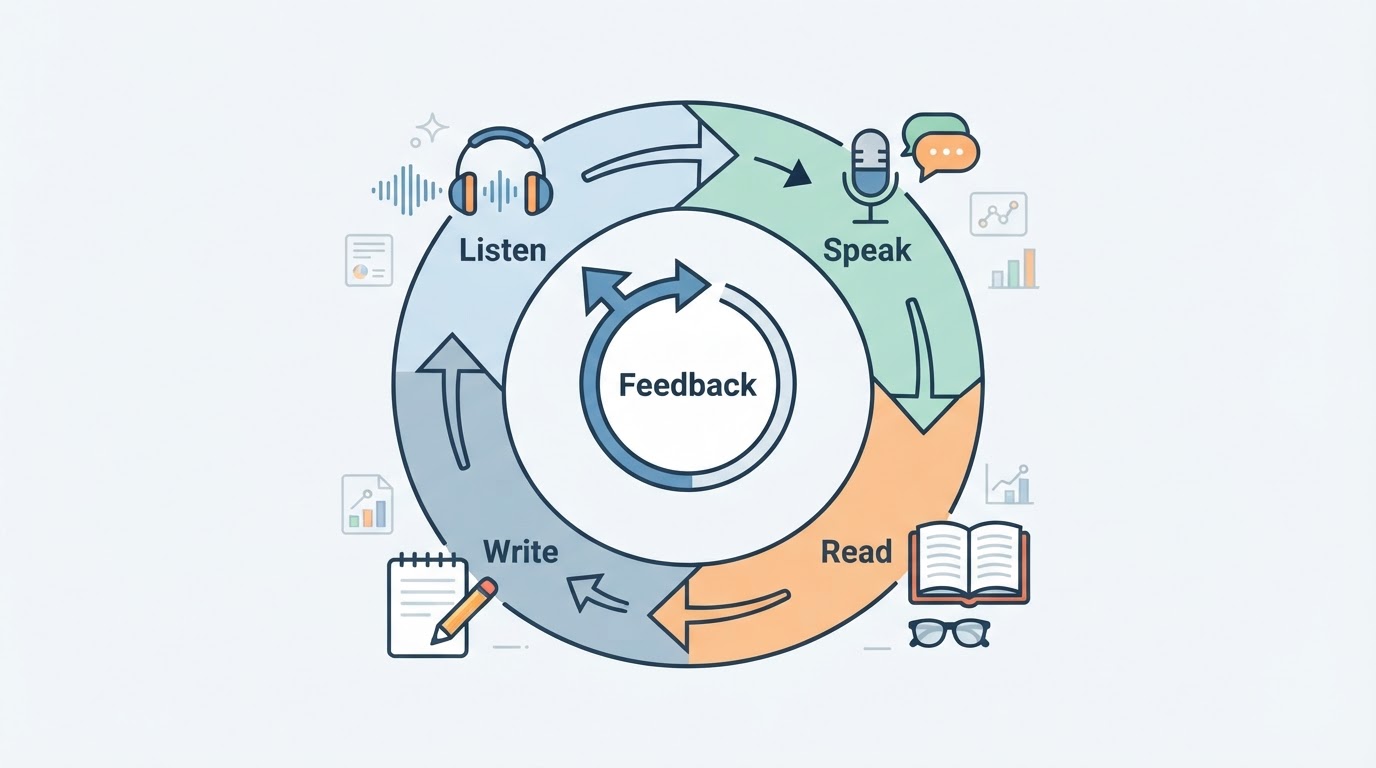
AI feedback closes the gap with a fast, repeatable check. Speech-to-text scoring compares what the system recognised against the sentence you were asked to read. When the recogniser hears a different word, that mismatch is a useful signal that a sound, an ending, or a stress pattern needs work. Because the check happens in seconds, you can correct a line while the memory of saying it is still fresh.
MANA Learn builds this check into its lesson flow as voice pronunciation scoring. According to the app's own product description, the feature uses speech-to-text analysis to evaluate how accurately you speak: you read aloud, and it returns immediate feedback on your pronunciation. The same description notes that the scoring is integrated into the lesson rather than a separate recording screen, which matters for habit building — you do not have to leave what you are studying in order to practise saying it. It is designed to encourage active speaking practice alongside the more passive parts of study, such as reading and listening.
That combination — immediate, specific, low-friction correction — is what makes a short daily loop more useful than an occasional long session.
What you need before the first session
A five-minute routine only works if the setup is already done. Prepare these five things once, and every later session can start immediately:
- A short passage at your level. Aim for something you can read aloud in about 60 to 90 seconds. Dialogue and sentences with clear punctuation work better than dense technical text, because punctuation gives you something to practise intonation against.
- Two target sounds or patterns. Not ten. Beginners usually get more from one consonant problem and one vowel or stress problem than from a broad "improve my accent" goal.
- A microphone you trust. A headset or earbuds with an inline mic reduce room noise, and a consistent mic position makes your feedback comparable from one day to the next.
- A note-keeping method. A single note on your phone is enough: the date, the passage, the words that were flagged, and the correction you tried.
- A fixed slot in your day. Attach the loop to something you already do — the first coffee, the commute, the walk after lunch.
With these ready, the drill itself becomes mechanical, and mechanical is what you want here. Decisions should be made once, not every evening.
The five-minute drill, step by step
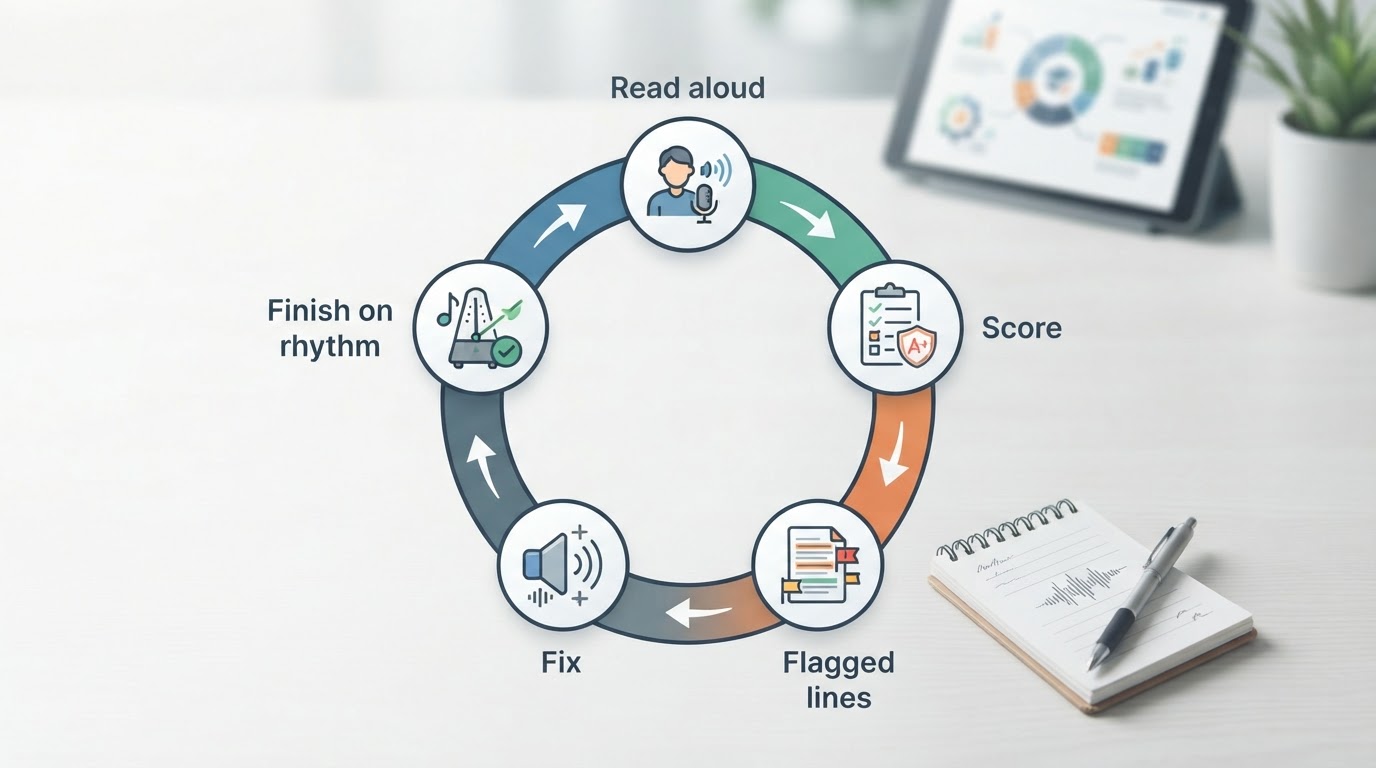
Step 1: Set your target for the day (20 seconds)
Write down the two sounds or patterns you picked. If yesterday's session ended with a stubborn word, that word becomes today's target. Keep the scope small enough that you can remember it without checking your notes.
Completion check: you can say your target out loud in one sentence, for example: "Today I am fixing final -ed endings and the vowel in ship versus sheep."
Step 2: Warm up with minimal pairs (60 seconds)
Say pairs of words that differ by only one sound — ship and sheep, light and right, thin and sin, fan and van. Say each pair slowly first, then at normal speed. The goal is not speed; it is making the contrast obvious to your own ear.
Completion check: you can hear and produce the difference between the two members of each pair without repeating the pair more than three or four times.
Step 3: Read the passage aloud once (60 seconds)
Read the whole passage at a comfortable pace, slightly slower than you would speak to a friend. Let the scoring run, and do not stop to correct yourself mid-sentence. You want an honest picture of what a listener hears, not a polished performance.
Completion check: the passage has been read from start to finish, and you have a short list of flagged words or sentences.
Step 4: Fix only what was flagged (120 seconds)
This is the part most learners skip. Take the two or three worst flagged items and work on them deliberately:
- Say the word slowly, one syllable at a time.
- Repeat it with the target sound exaggerated.
- Say it at normal speed inside the original sentence.
- Say the sentence again and compare the result with the first attempt.
The feedback matters less than the comparison. You are looking for the moment when the flagged word stops being flagged — that is the loop doing its job.
Completion check: every flagged item has been retried at least twice, and at least one has been cleared.
Step 5: Finish on rhythm and intonation (60 seconds)
Sounds alone do not make speech clear. Take the final two sentences of the passage and focus on the shape of the line: which word carries the main stress, where the voice rises, and where it falls. English sentence stress is not decoration — misplaced stress can make a correct sentence harder to follow than a single wrong vowel.
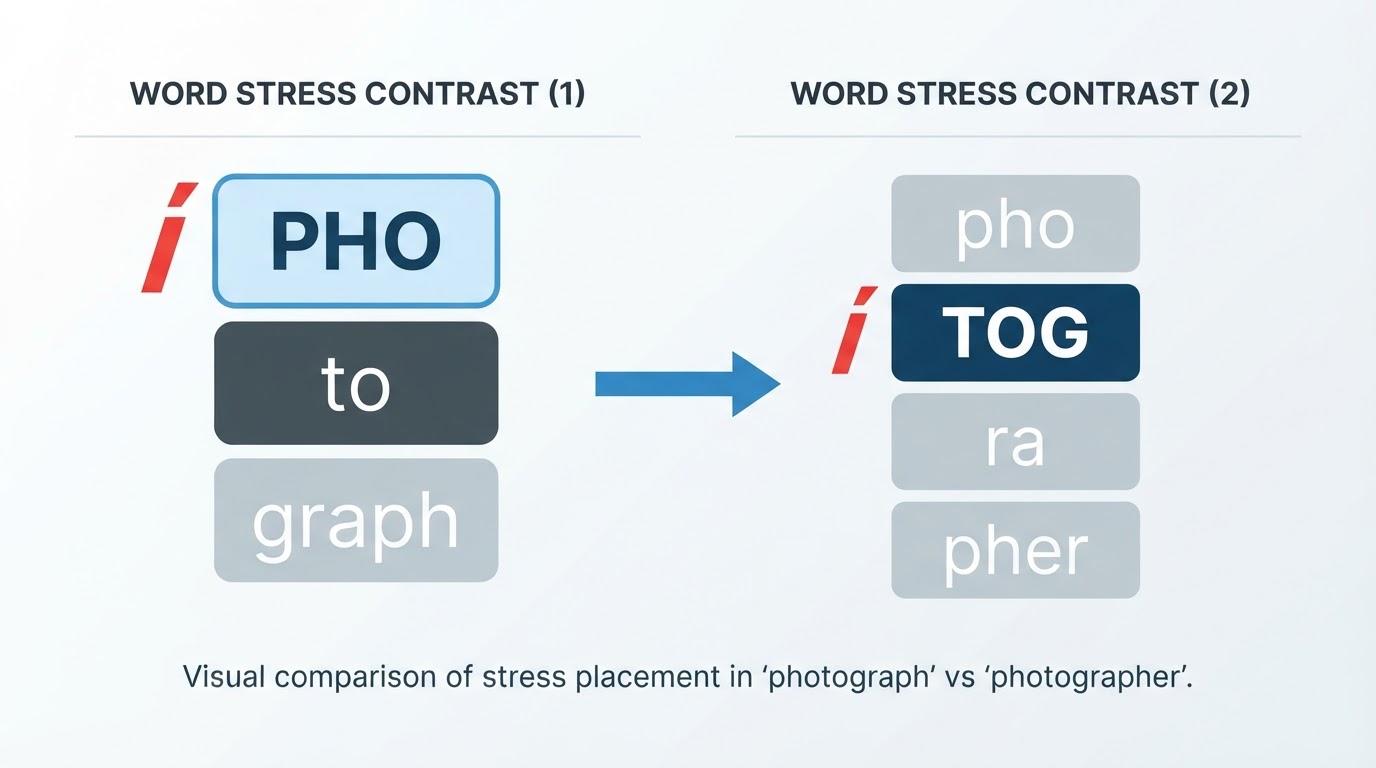
Completion check: you can mark the stressed word in each of the two sentences and repeat them with the same stress pattern.
Completion standard for the whole session: five focused minutes, one loop through the steps, and a note of what improved and what is still pending. Pronunciation improves cumulatively rather than dramatically, so the loop is designed to make a small daily correction easier to keep than a weekly overhaul.
Common pronunciation pitfalls AI feedback catches
Most flagged words fall into a small number of patterns. Learning to recognise them turns a vague score into a specific instruction.
Pitfall | What listeners notice | Drill focus |
|---|---|---|
Dropped final consonants | Plural -s or past -ed disappears, so walked sounds like walk | End the word deliberately, then blend it into the next word |
Voicing and place confusions | v/w, th/s, l/r, or p/b pairs collapse into one sound | Minimal pairs first, then the same contrast inside short sentences |
Vowel length | ship and sheep, or full and fool, become the same word | Hold the long vowel for two beats before shortening it |
Misplaced word stress | The right sounds in the wrong rhythm still sound unfamiliar | Mark the stress in every multi-syllable word before reading |
Flat sentence intonation | Questions sound like statements, and lists sound unfinished | Read the punctuation aloud: rise inside a list, fall at a full stop |
Connected speech | Word-by-word reading sounds choppy and unnatural | Read the line as one unit, then slow it down only where required |
The table is diagnostic rather than decorative. If most of your flags cluster in one row, your next two or three sessions should stay on that row instead of wandering across the whole list.
How to read AI pronunciation feedback without chasing the score
A score is a useful instrument, not a verdict. Understanding what it measures — and what it does not — is what keeps a daily loop productive instead of discouraging.
Speech-to-text scoring mainly measures whether the words you produced were recognised as the words you were asked to read. That makes it excellent for catching wrong sounds, missing endings, and unclear syllables. It is less able to judge natural rhythm, emotional tone, or whether an accent sounds pleasant to a particular listener. A sentence can score well while still sounding heavily accented, and a sentence can score badly because of background noise rather than a pronunciation error.
MANA Learn's description of its scoring is deliberately narrow: it covers spoken accuracy and immediate feedback, not naturalness or conversational timing. Treat it that way, and the daily loop stays honest:
- Use the score to find patterns, not to chase a perfect number.
- Re-record a flagged line once in a quieter place before assuming the error is yours.
- Judge progress by whether specific sentences became easier, not by whether the number moved today.
- Keep some practice that has no score at all — reading aloud for pleasure, or talking with a person — so fluency does not become a measurement exercise.
Accent reduction is not the goal. Being understood comfortably is. A learner who keeps a noticeable accent but pronounces final consonants and stress patterns reliably will be easier to follow than one who suppresses the accent but blurs word boundaries.
FAQ
How long does it take to improve English pronunciation with AI feedback?
There is no fixed timeline, because it depends on your starting point, your target sounds, and how consistently you practise. What the feedback loop changes is the speed of noticing: errors that used to pass unnoticed are flagged within seconds, so your practice time goes to the right lines instead of to a full repeat of everything. Progress tends to appear first in the specific sentences you drill, and later in unscripted speech as those patterns carry over.
Can I improve pronunciation with AI feedback alone?
AI scoring is strong at repetition, immediate correction, and private practice, which makes it especially useful if you feel self-conscious about speaking. It cannot fully judge naturalness or conversational timing, and it will not teach you how to steer a fast conversation. Use it as the daily drill, and add real listening and real conversation as the place where the drilled patterns get tested.
What should I do when the same word is flagged again and again?
Change the unit of practice. Slow the word down to individual syllables, isolate the vowel or consonant that causes the mismatch, and build it back up inside the sentence. If the word still resists, check whether it actually affects understanding — some words are worth perfecting, and some are worth accepting. Persistent flags on one quirky word are not evidence that your English is failing.
Do I need a quiet room to practise with AI feedback?
No, but background noise affects how your speech is recognised, so a quieter corner gives cleaner feedback. A headset with a microphone helps. If your only option is a noisy commute, keep the phone close to your mouth and treat a sudden drop in the score with suspicion until you have retried in a calmer place.
Should I practise sounds or whole sentences first?
Start with sounds in isolation only long enough to hear them, then move into whole sentences immediately. A sound you can produce alone but never inside a sentence has not been learned yet. The sentence is the unit a listener actually hears.
Takeaway
To practice English pronunciation with AI feedback well, keep the loop small and the feedback specific. Read a short passage aloud, let speech-to-text scoring flag what slipped, spend most of your time on those flagged lines, and finish with rhythm and intonation. Five minutes done daily will teach your mouth more than an hour done occasionally, and the score is there to point you at the next sentence — not to grade you.