What a CEFR level test can and cannot tell you
The Common European Framework of Reference for Languages, usually shortened to CEFR, describes language ability in six levels from A1 to C2. A level test samples your current performance and estimates where you sit on that scale. It is a map of what you can do today, not a verdict on your talent for languages.
That distinction matters because learners often treat a single score as a permanent label. A result moves with the conditions around it: how rested you are, how familiar the topic is, and how much speaking the test asks for. It also samples a limited set of tasks, so it can underrate or overrate a skill you use every day in real life.
What the CEFR is genuinely good for is planning. Once you have a working level, you can pick material that matches it, set a target for the next level, and measure movement over time. What it cannot do is tell you how much effort you have put in, how fast you will progress, or how you compare with every other learner. Use it as a working hypothesis that you revise, not as a ranking.
The six CEFR levels in plain language
The CEFR groups its six levels into three broad bands. A1 and A2 are the basic user band, B1 and B2 are the independent user band, and C1 and C2 are the proficient user band. The band names matter less than the "can do" descriptions behind each level.
Level | Common label | What you can generally do |
|---|---|---|
A1 | Beginner | Use basic phrases, introduce yourself, and ask simple questions about familiar topics. |
A2 | Elementary | Handle everyday routines, short exchanges, and simple descriptions of people and places you know. |
B1 | Intermediate | Deal with familiar topics, explain opinions briefly, and cope with standard travel or work situations. |
B2 | Upper intermediate | Discuss a wide range of subjects with reasonable fluency and follow complex arguments on familiar ground. |
C1 | Advanced | Use language flexibly for academic or professional purposes and express ideas precisely. |
C2 | Proficient | Understand virtually everything you hear or read, and express nuance spontaneously. |
Read each row as an ability you can demonstrate consistently, not as a topic you once studied. If you have covered the passive voice in a textbook but cannot use it in a conversation, that is a study topic, not a level. The same logic applies in reverse: daily conversation can leave reading and writing behind, so the four skills deserve separate attention.
How to find your level in one session
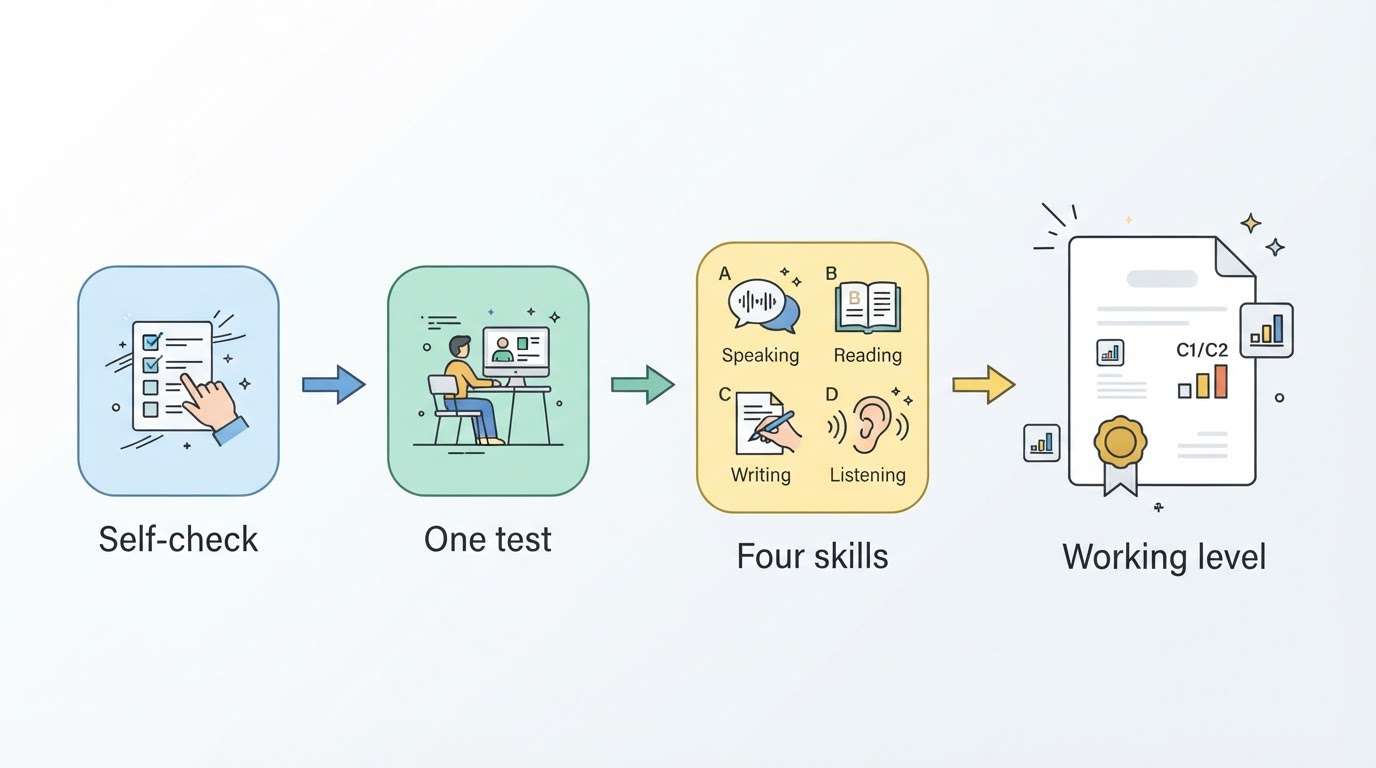
You need three things before you start: the level descriptions above, a quiet block of thirty to forty-five minutes, and a way to record a short sample of your speech. Then work through four steps.
1. Mark the descriptions you can meet today. Start at A1 and read upward. Tick only statements you could handle right now, without preparation, most of the time. Stop when the misses start to outnumber the hits. The last level that is mostly true is your floor.
2. Take one placement-style test as a cross-check. Many courses and apps offer a short test that maps a result to a CEFR level. Take one, note the level it suggests, and treat it as a second opinion rather than a final answer. If it agrees with your floor, you can plan with more confidence; if it disagrees, the four-skill check will show you why.
3. Check the four skills separately. Do one short task per skill at your candidate level: listen to a short clip, read a page of text, record two minutes of speech, and write a short paragraph. Mark which skills hold up and which fall away. Speaking is the skill learners most often underestimate, because conversation gives you no time to edit yourself.
4. Write your working level and your gap. Your working level is the level that holds across most skills. Your gap is the skill that sits a level or two below it. Write both down, along with two or three errors you noticed while working.
You are done with this session when you can say three things out loud: your working level, the skill that lags behind it, and the level you are aiming at next.
How to move from one level to the next
Progress rarely comes from studying harder. It comes from practicing at the edge of what you can already do and correcting the same mistakes as they appear.
Practice at your working level, not below it
Material that is too easy feels productive but introduces little new language. Material that is far too hard pushes you into guessing. The useful zone is content you mostly understand that still contains a handful of unknown words or structures per minute. Short daily sessions of three to five minutes keep you in that zone without asking for a big block of time.

If your schedule is tight, shorter and more frequent beats longer and rarer. Five minutes a day gives you more feedback cycles per week than one long session on the weekend, and busy professionals in particular tend to stick with the shorter version.
Build feedback into every session
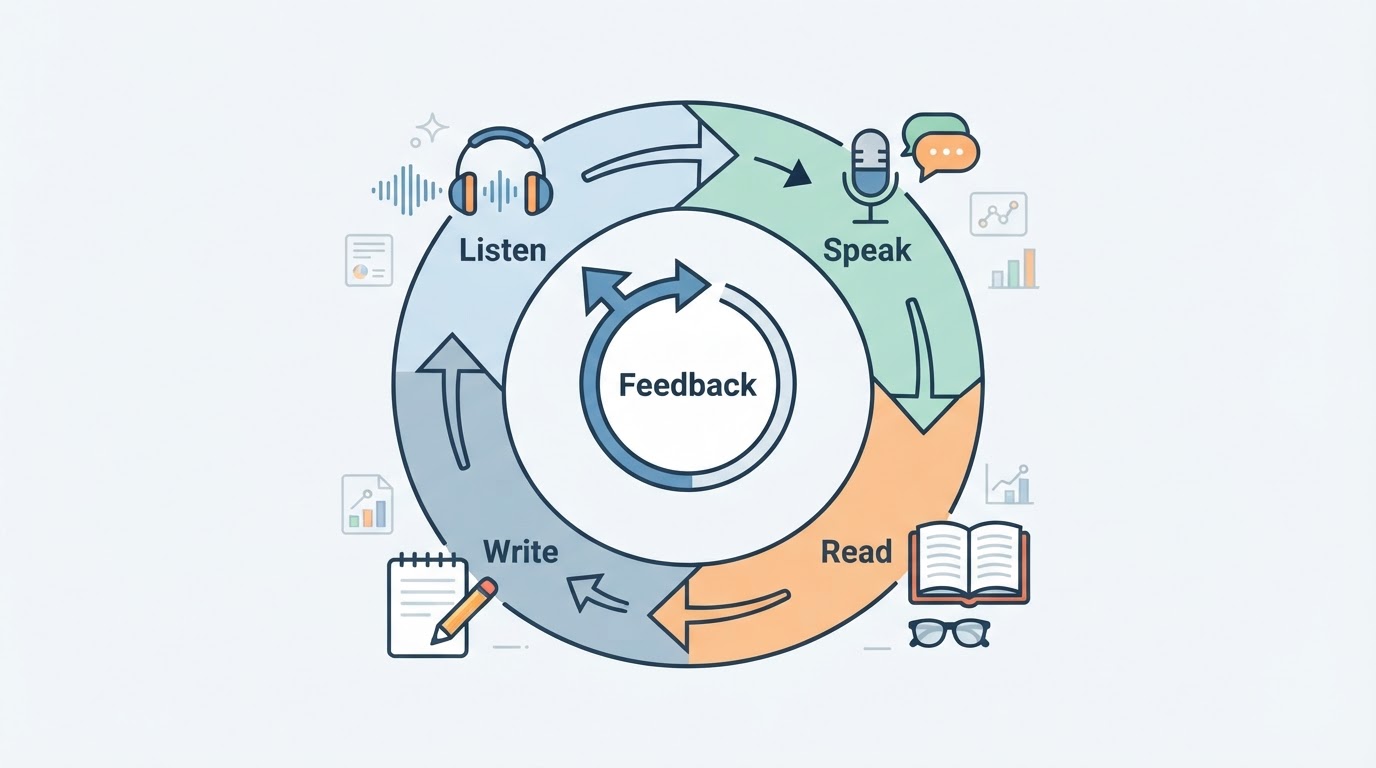
Feedback is what turns practice into progress, and it does not have to come from a teacher. Two cheap ways to add it:
- Read a short text aloud and compare your delivery with a model, or use a tool that scores pronunciation and shows which sounds drifted.
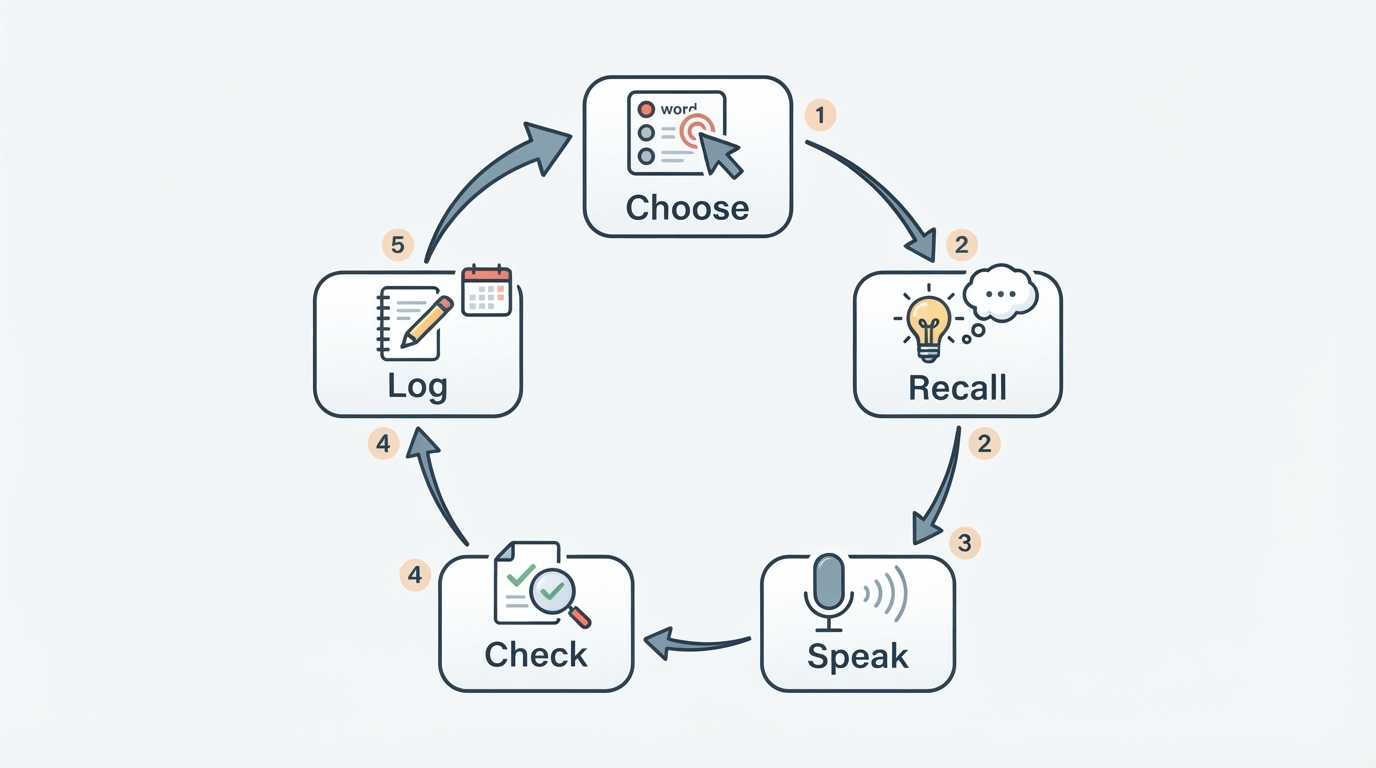
- After each session, note what you could not say, then check how a fluent speaker would express it and use the corrected version the next day.
Review your errors on a schedule
Keep the error list from your first session and add to it. Once a week, reread the list and turn the three most common mistakes into three targeted exercises. This is where most visible movement happens, especially between B1 and C1: the same small set of mistakes is removed one at a time instead of being masked with more vocabulary.
Retest to confirm, not to collect scores
Test again every few weeks, using the same task types as your first assessment so the comparison is meaningful. If the descriptions for the next level now feel consistently manageable, move up. If they do not, check the error list before changing your routine; a plateau usually means one skill needs attention, not that you have stopped improving.
Evaluating a free CEFR-aligned app
An app is only worth your time if the parts you need stay inside the free tier. Rather than comparing marketing pages, judge any option against the same short checklist:
Question | Why it matters |
|---|---|
Does each course state its CEFR level, from A1 to C2? | A named level lets you practice at the right difficulty instead of guessing. |
Are listening, speaking, reading, and writing all covered? | Four-skill coverage keeps your weak skill from falling further behind. |
Does the lesson sequence adapt as you progress? | A fixed order for every learner ignores the gap you just identified. |
Is feedback available inside the session? | Immediate explanations and corrections are what move you up a level. |
Can you see your position on the level scale? | A visible position makes retesting and goal setting meaningful. |
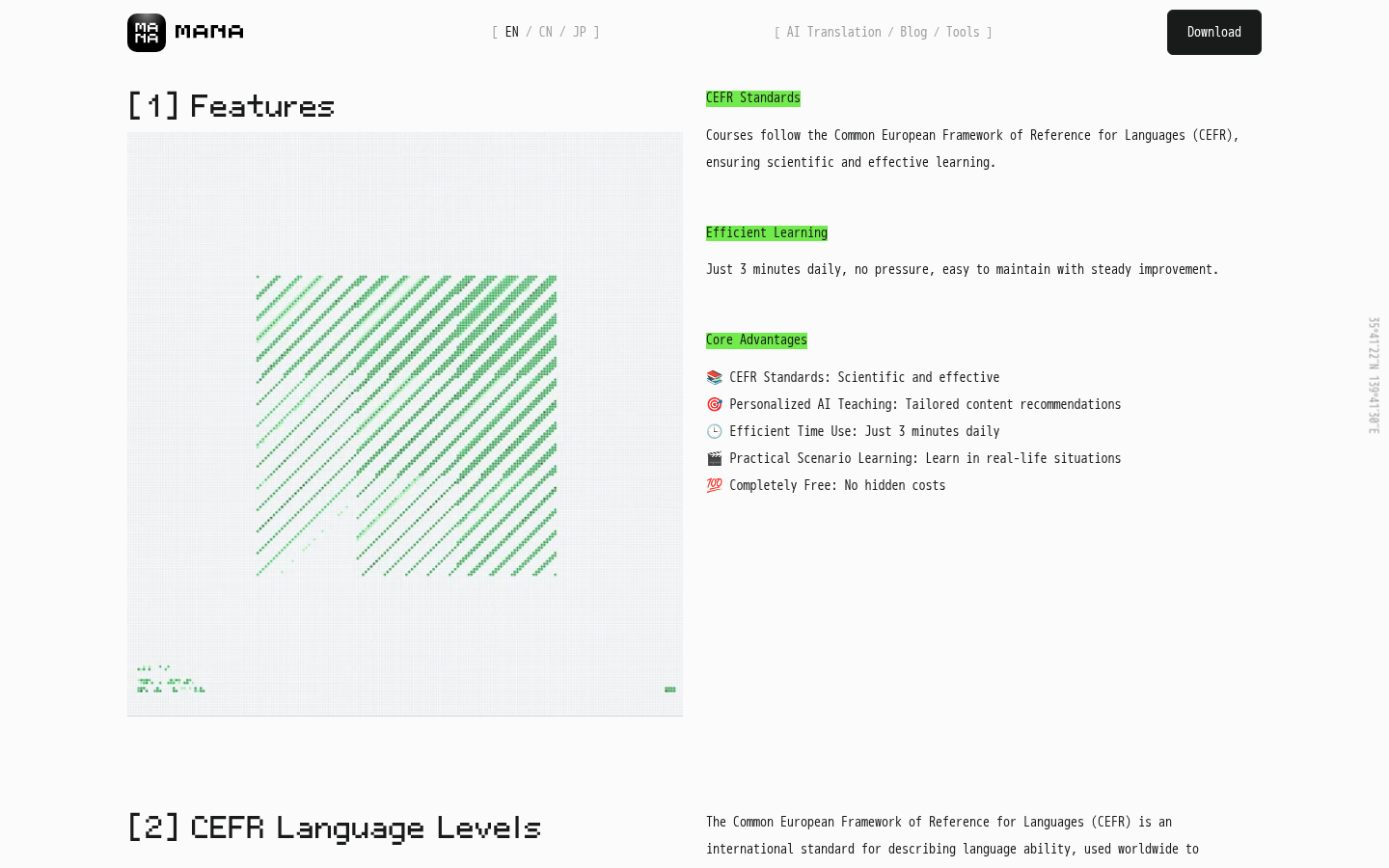
MANA Learn is one example that organizes its courses this way. Its CEFR-aligned courses run from A1 to C2 across listening, speaking, reading, and writing, and the lesson sequence adapts as a learner progresses through the levels. Check it against the same checklist you apply to anything else, and keep the criteria ahead of the brand.
Felo product screenshot.
FAQ
Is a CEFR level the same as an exam result?
No. The CEFR describes ability, while an exam or certificate measures it against a fixed standard. A placement test or a self-assessment estimates your level; an exam records evidence of it. You can use the level descriptions to prepare for either.
Can I be at different levels for different skills?
Yes, and most learners are. Reading and listening often sit one level above speaking and writing, because they give you time to process and repeat. Use the lower skill to set your working level, and the higher one to show what is already within reach.
How often should I retest?
Often enough to see movement, rarely enough to leave time for practice. Every few weeks, with the same task types as your first assessment, is usually enough to tell whether the next level's descriptions have become manageable.
Do I have to finish every A1 lesson before starting A2?
No. Work through the material until the A1 descriptions feel routine and the first A2 descriptions no longer look out of reach. Then move on, and keep reviewing the errors that follow you.
The takeaway
Treat your CEFR level as a working hypothesis. Find it once with a mix of self-assessment and one test, practice daily at that level with feedback, review your errors each week, and retest every few weeks. The number tends to follow the practice; chasing the number rarely works the other way around.