What an AI grammar tutor does well
A grammar tutor is something you go to with a specific language question. When that tutor is powered by AI, the answer arrives in seconds, in plain language, and you can ask follow-up questions without worrying about taking up someone's time. That immediacy is the point. Most learners do not need a lecture on the passive voice; they need two clear sentences about why their own sentence sounds off.
Three jobs are worth giving an AI grammar tutor: explaining a rule in context, diagnosing a mistake in your own writing, and generating practice on the spot. An explanation names the pattern. A diagnosis shows where your sentence breaks it. Practice makes you produce the pattern yourself, which is the only part that turns understanding into habit. A tool that does only the first job well will leave you knowing more grammar and still making the same errors.
It also helps to be clear about the limits. An AI tutor has no record of your goals unless you state them, no idea what your course is covering this week, and no accountability for whether you improve. It can state a confident rule that does not hold in every case. Treat each answer as a strong first draft from a well-read assistant rather than a final ruling, and test it against examples you can verify.
The five-minute daily loop
Short sessions work because they remove the two biggest reasons grammar practice stalls: finding a free hour, and not knowing what to study. Five minutes fits between other tasks, and one sentence is enough material to work with.
Before your first session
Choose a three-to-five-minute slot you can keep, ideally straight after something you already do, such as morning coffee or the end of the workday. Keep one running error log in a notes app or notebook with three columns: the sentence, the correction, and the rule in your own words. Name a single pattern you want to stop repeating, like article choice or past tense endings. One pattern at a time is enough; a list of ten defeats the format.

The loop itself
Run these six steps in order. The whole cycle fits in five minutes.
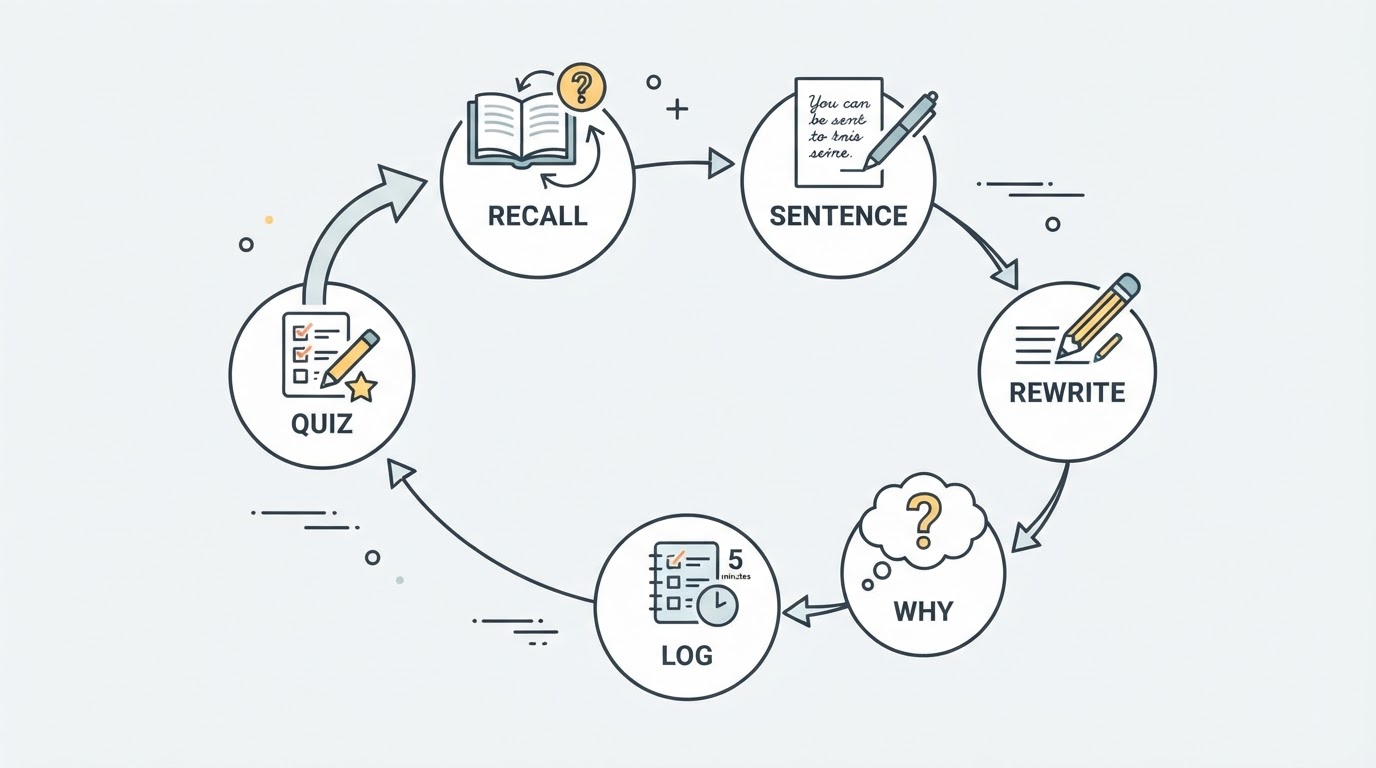
- Recall (30 seconds). Say yesterday's rule out loud from memory before you look anything up. If you cannot, that rule stays on the list for today.
- Bring one real sentence (60 seconds). Use something you actually wrote: an email, a message, or a paragraph from a draft. Textbook sentences hide the errors you really make.
- Fix it first (90 seconds). Rewrite the sentence yourself before asking for help. Your version gives the tutor something to compare against, and the gap between your attempt and the correct form is where the learning happens.
- Ask why, not just what (60 seconds). Request the rule behind the correction, plus a second example that uses the same pattern in a different way.
- Log the pattern (30 seconds). Write the rule in your own words with one example. If you cannot phrase it simply, you have not understood it yet; ask again.
- Close with a micro-quiz (30 seconds). Ask for two similar sentences that test the same rule tomorrow. Those sentences become your next recall step.
How to tell a session worked
You are done when you can explain the rule without the tutor, spot the error in a new sentence, and write a correct example from scratch. If any of those three fail, keep the same pattern tomorrow instead of adding a fresh one. Two minutes on the same rule beats five minutes on a new rule, because repetition is what moves grammar from recognition into habit.
Question patterns that earn better answers
The quality of the answer tracks the quality of the question. A vague question returns a general explanation; a specific question returns something you can use on the next sentence you write.
Ask for reasoning, not verdicts
Compare "Is this correct?" with "Is this correct, and if not, which word breaks the rule and what is the rule?" The second version forces a diagnosis you can reuse. Follow up with "Why does it work that way?" until the rule is short enough to say out loud.
Use your own sentences
Bring the sentence you wrote. "Here is a sentence from my report. Which part is weakest, and why?" Then ask for a rewrite that keeps your meaning, plus a short list of what changed. This turns a general explanation into feedback on your actual writing.
Ask for contrasts
Grammar confusion is usually a contrast problem: two forms that look interchangeable but are not. Ask the tutor to compare them inside a sentence you wrote, then ask for one sentence where each form is clearly the right choice. The contrast gives you a decision rule instead of a definition.
Ask it to test you
Once you think you understand a pattern, switch roles: "Give me three sentences with one error each. Show one at a time, wait for my fix, then explain what I missed." Checking your own answers is more useful than reading a list of correct ones.
Turn rules into checklists
Ask the tutor to compress a pattern into a checklist you can run before you send an email or submit a draft. A three-item checklist gets used; a paragraph of grammar theory usually does not. Keep the checklist in your error log and update it when a new mistake appears.
Instead of asking | Ask | Why it works |
|---|---|---|
"Is this correct?" | "Is this correct? If not, which word is wrong and which rule applies?" | You get a diagnosis and a rule to remember |
"Explain the present perfect." | "Explain the present perfect versus the past simple using this sentence I wrote: ..." | The explanation attaches to your own example |
"Give me grammar exercises." | "Give me five sentences that practice articles, one at a time, and wait for my answers." | Practice stays focused and interactive |
Common grammar struggles and how to study them
Some patterns trip up nearly every learner of English, and each one rewards a different kind of drill. The common thread is production: you have to write or say the pattern to own it.
Articles and determiners
Choosing between a, an, the, and nothing depends on countability, whether the reader already knows the noun, and whether you mean a specific thing or a category. Instead of memorizing a rule list, collect ten sentences from your own writing that use these words and ask the tutor to explain each choice. The repeating patterns will surface faster than any summary can.
Verb tenses and aspect
Most tense questions are really timeline questions: when did it happen, is it finished, and does it still matter now. Sketch the timeline before you pick a form. Ask the tutor to place your sentence on its own timeline and name the moment each verb points to, then rewrite the sentence for a different moment and compare.
Prepositions
Prepositions resist logic because they attach to the word they follow: "interested in", "depend on", "good at". Learn them as phrases, not as free-standing rules. Every time you meet a new one, add the whole phrase to your log and ask the tutor for two more common phrases with the same pattern. A short personal list beats a long reference table you rarely open.
Subject-verb agreement and sentence boundaries
These errors often survive proofreading because the sentence sounds fine when read quickly. Read the sentence aloud, or strip the modifiers to find the core subject and its verb. For run-on sentences and comma splices, ask the tutor where one clause should end, then rewrite it yourself with a period, a semicolon, or a conjunction and compare the three versions.
Word order and modifiers
English word order carries meaning, so a misplaced adverb or modifier can change what a sentence says. Ask the tutor to move the modifier and describe how the meaning shifts each time. Reordering your own sentence teaches the constraint faster than memorizing positions on a chart.
Habits that compound
- One pattern a week. Pick the error that costs you the most clarity and give it the whole week.
- Produce, then check. Write your version first, compare second. Guessing before the answer arrives is what makes the correction stick.
- Review your log on a schedule. Re-read last week's entries before you start a new pattern; old mistakes return quietly.
- Read your writing aloud. Agreement and boundary errors are easier to hear than to see.
- Save the hard questions. When an explanation does not satisfy you, note it and check a reference grammar or a teacher later.
A worked example: MANA Learn's AI tutor
MANA Learn describes its AI tutor as an on-demand assistant that explains words, sentences, and grammar and answers questions about language content you meet during study. The app's own description says the tutor explains vocabulary, sentence structure, and grammar rules in context. That places it squarely in the "bring your own sentence" step of the loop above.
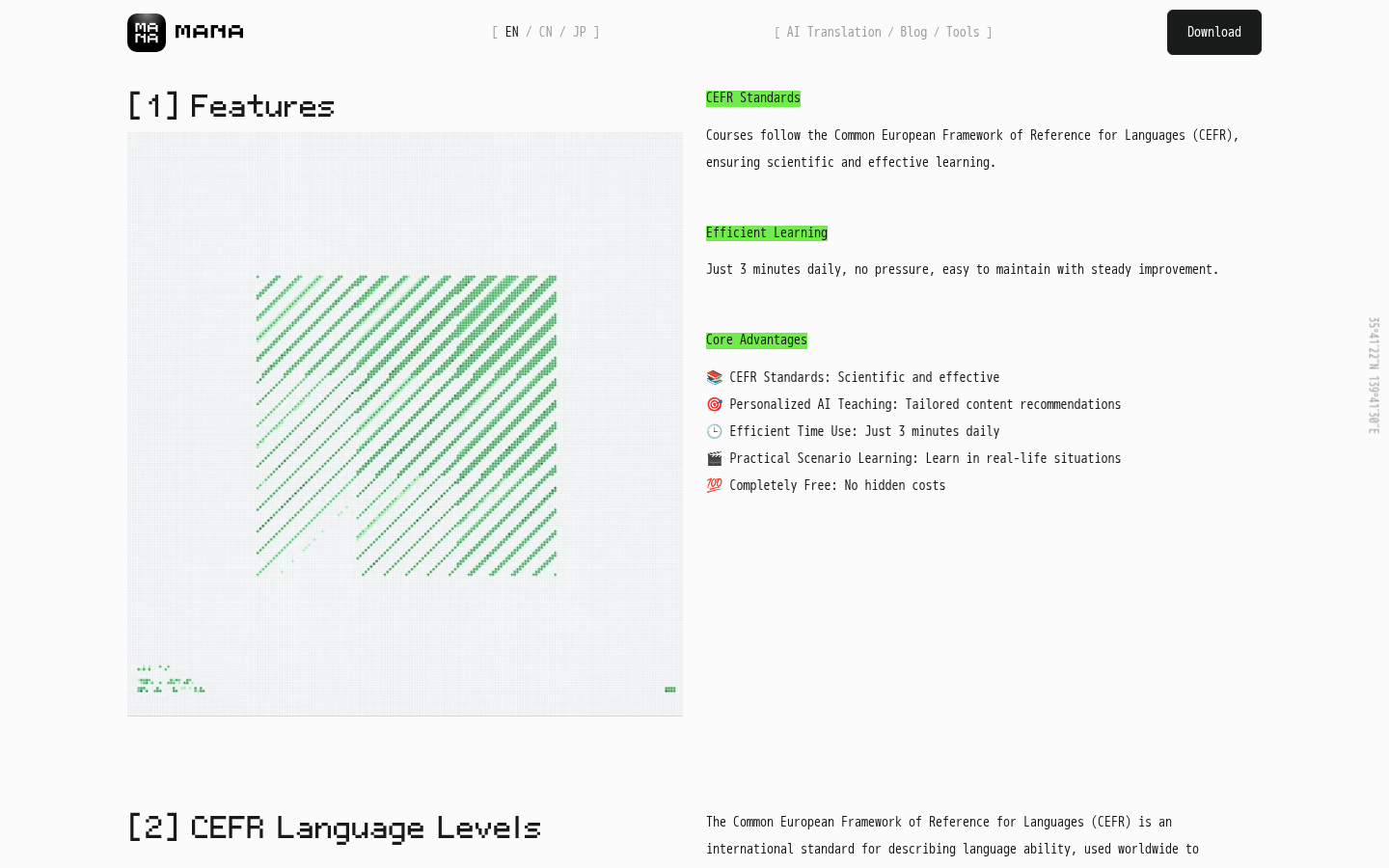
Felo product screenshot.
You would use it the way this guide describes: paste the sentence you wrote, ask why it reads the way it does, then ask for two similar sentences that test the same pattern. MANA Learn frames the tutor as part of short daily sessions, which matches the format this routine assumes. Even with a tutor available at any hour, the learning still comes from the sentence you produce and the question you ask about it.
FAQ
Can an AI grammar tutor replace a teacher?
No, and it is not built for that. A teacher sets the curriculum, judges register and appropriateness, and holds you accountable week after week. An AI tutor is best at the high-frequency questions a teacher cannot answer the moment they appear: why this article, why this tense, why this preposition.
How long before I see progress?
Judge progress by your own error log rather than by how much grammar you have read. When the same mistake appears less often in your writing, the pattern is moving from understanding into control. Keep the log long enough to make that comparison possible.
What should I do when the tutor's answer looks wrong?
Do not memorize it. Ask for the reasoning and two more examples, then test the rule against a sentence you know is correct. If the answer still looks wrong, check a dictionary, a reference grammar, or a teacher. A wrong answer you catch is still useful practice, because it forces you to compare evidence.
Should I practice in the target language or my native language?
Use the target language for straightforward explanations and examples, since those words will come up again in real use. Switch to your native language when an explanation turns into dense terminology, then translate the final rule back into the target language for your log.
Do I need to write, or is reading enough?
Reading builds recognition; writing builds control. Spend most of the session producing sentences and checking them, and use explanations mainly to unblock the next attempt. Reading about a rule is preparation, not practice.
Takeaway
Five minutes, one pattern, one real sentence, and a question about why. Do that most days, record each rule in your own words, and review the log before you start a new pattern. An AI grammar tutor will not make anyone fluent by itself, but as a daily sparring partner for the grammar you actually use, it removes the two biggest obstacles: waiting for feedback and not knowing what to ask.