Why 3 to 5 minutes a day beats weekend marathons
Language skills fade without contact. A short daily session keeps vocabulary and sentence patterns in working memory, so each new lesson starts from recognition instead of a cold restart. Micro-sessions also survive busy weeks: a commute, a coffee break, or the minutes before sleep are easier to protect than a two-hour weekend block that competes with everything else on the calendar.
Frequency buys retrieval, not depth. That trade-off is worth naming. Three to five minutes a day builds the habit and keeps all four skills warm, but it will not replace longer, deliberate practice if you are preparing for an exam, a job interview, or a relocation. Treat the micro-session as the foundation, and add one longer session a week when your goal demands it.
There is a second trap. Short sessions reward passive behavior, because tapping through lessons feels like progress. If you finish a session without producing a spoken or written sentence that received a correction, you practiced recognition, not retrieval.
What a 3 to 5 minute session should contain
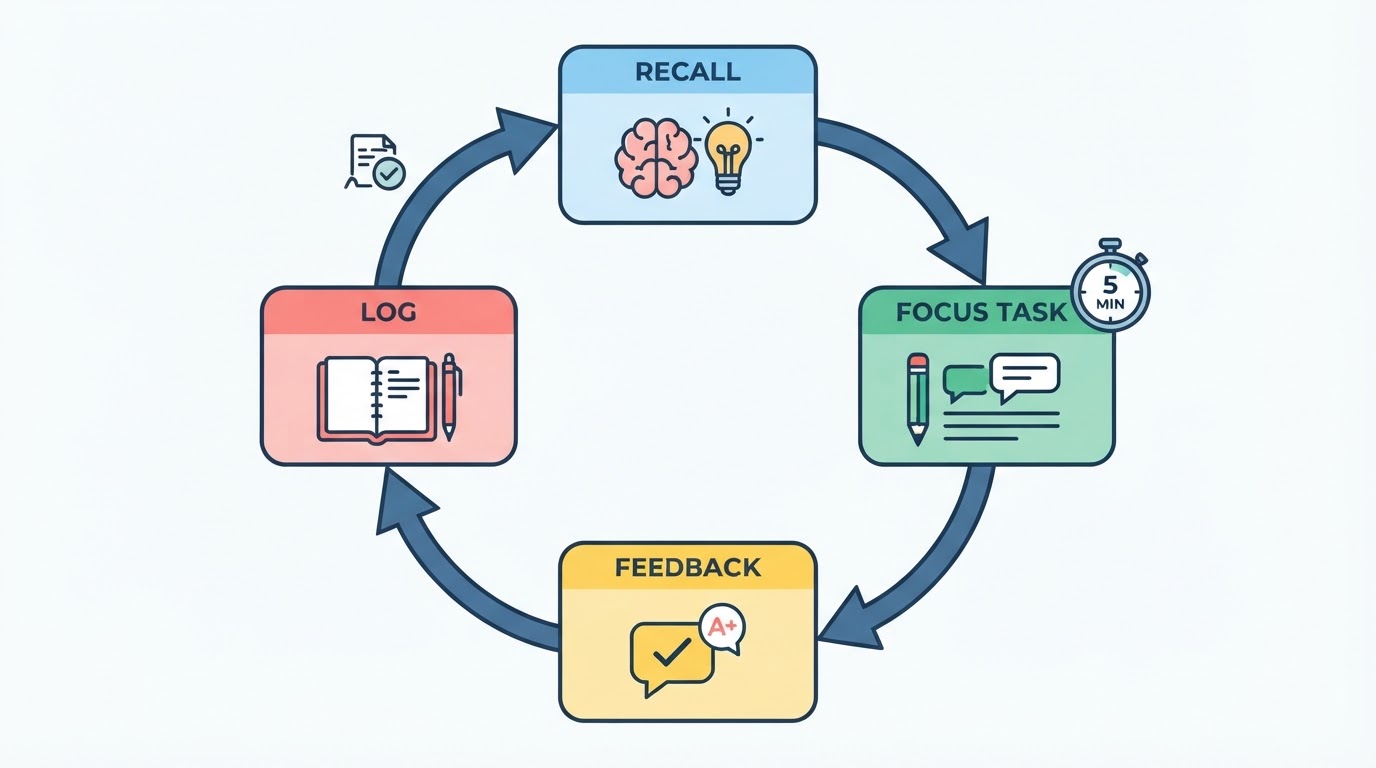
Every session in this plan follows the same loop, and the loop matters more than the length.
Block | Time | Purpose |
|---|---|---|
Recall | 30 to 45 seconds | Retrieve yesterday's correction before new material |
Focus task | 90 to 120 seconds | One micro-task in a single skill |
Feedback | 45 to 60 seconds | Produce something and get it corrected |
Log | 15 seconds | Write one line for tomorrow |
The completion standard never changes: one thing you produced, one correction you received, and one item carried into tomorrow's recall block. A session that ends without a correction was input practice — useful, but not the same thing.
Keep the AI in a feedback role rather than a deciding role. Ask it to correct your sentence, explain the rule behind the correction, and offer one alternative phrasing. Then say or write the improved version yourself, out loud or on paper, before the session ends.
Set up the plan before day one
Four decisions make the week run without willpower.
1. Name your level and your target. A rough CEFR self-check is enough: A1 to A2 means you are building basic phrases, B1 to B2 means you can handle connected text and everyday conversation. Then define what better looks like in 30 days — holding a 60-second self-introduction, writing a short work email, or following a podcast segment without captions.
2. Choose one anchor time. Pick a slot you already live through daily: the train commute, the first coffee, the walk after dinner. Same time, same place, five days a week. The habit carries the plan on days when motivation does not show up.
3. Prepare the night before. Open or download tomorrow's material and choose the three phrases you will work with. This removes the two minutes of setup friction that usually turns into skipping.
4. Pick your tool against a checklist. Free tiers differ, and AI features move between plans, so compare before you commit. Four questions do most of the work: does the tool explain mistakes in context, does it score pronunciation, does it follow a visible progression such as CEFR levels A1 to C2, and what exactly does the free tier include? Confirm the current terms on the product's own pricing page rather than trusting an old review.
MANA Learn is one example to check against that checklist: according to the product information MANA Learn publishes, its courses are aligned to CEFR levels A1 to C2 and cover listening, speaking, reading, and writing, with AI that adapts lesson sequencing to each learner's progress.
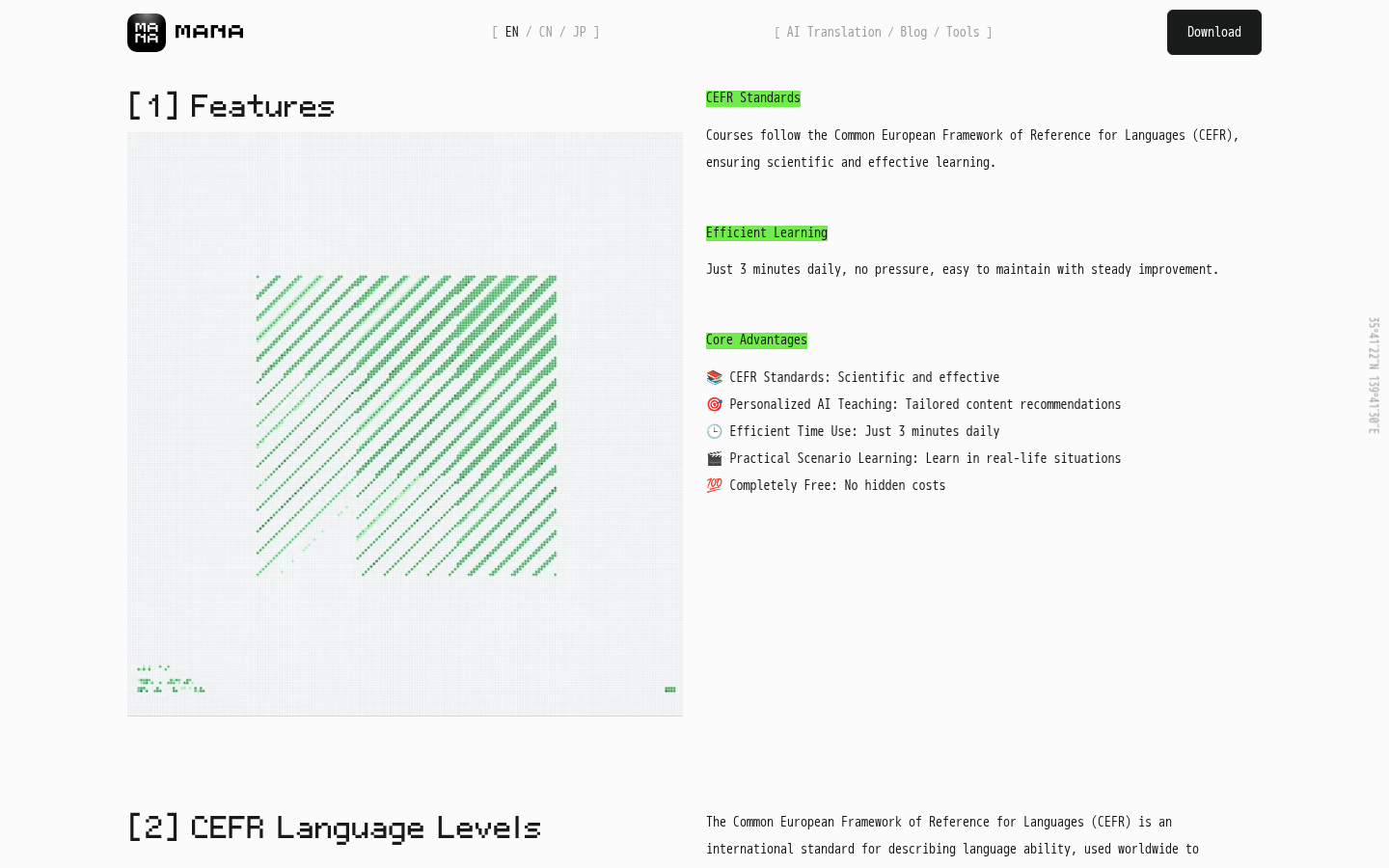
Felo product screenshot.
The 7-day practice plan
Each day takes three to five minutes, follows the same four-step loop, and focuses on one skill. Days 5 and 6 combine two skills so the week covers listening, speaking, reading, and writing twice.

Day 1: Listening
Pick a 30 to 60 second clip at your level. Listen once without text, read the transcript once, then play it again and shadow the speaker out loud, matching rhythm and stress. Ask the AI to explain one phrase that surprised you, and log that phrase for tomorrow's recall block.
Day 2: Speaking
Take three sentences from yesterday's clip and read them aloud inside your app's pronunciation practice. Re-record the word or syllable that scored lowest, and stop when the second attempt clearly improves. Finish by saying all three sentences once without looking at the feedback screen. Log the corrected phrase, not the original mistake.
Day 3: Reading
Read a 100 to 150 word paragraph on a topic you actually care about. Mark two words or structures you cannot explain, ask for in-context explanations, and write one sentence of your own with each. Log the sentence that felt most natural.
Day 4: Writing
Write three sentences about your day and ask for corrections plus a clean rewrite. Compare the two versions and name the error type in one line of your own words. Rewrite the weakest sentence yourself, then log the error type — it becomes tomorrow's recall item.
Day 5: Listening and speaking
Replay Monday's clip and speak one side of the dialogue out loud during the pauses. Ask for one alternative phrasing for a line that felt awkward, say the alternative three times, then record your improved conversation and listen back once. Log the phrasing you want to keep.
Day 6: Reading and writing
Read a short text, then summarize it in two sentences. Ask which sentence is weaker and why, rewrite that sentence, and log one phrase worth reusing in your own writing.
Day 7: Review and calibrate
Spend the full five minutes on recall instead of new material. Work through the week's logged items, say every correction out loud in one 60-second monologue, and pick the skill that felt shakiest. That skill takes the Monday and Thursday slots next week. If everything felt easy, raise the input level rather than adding minutes.
Scheduling tips for busy learners
- Anchor the session to an existing habit. A plan that depends on spare time will compete with everything else. A plan attached to your commute does not need a decision.
- Use a two-minute floor. On chaotic days, do the recall block plus one spoken sentence. Two minutes keeps the chain intact and costs far less willpower than deciding whether to skip.
- Prepare tomorrow tonight. Material ready, phrases chosen, notification set. Friction is the main reason good routines die in week two.
- Split the session if your day is fragmented. Two minutes of recall in the morning and three minutes of production at night is the same plan, carried in two pockets.
- Do not restart after a missed day. Continue with the next day in the sequence and let the missed skill wait for the following cycle. Restarting resets the log, which is the most useful part of the system.
- Protect the weekly review. Short sessions work because the seventh day consolidates them. Ten minutes of review once a week is what turns daily contact into retained knowledge.
Common mistakes that waste the three minutes
- Input-only loops. Watching explanations without ever producing a sentence feels productive and changes very little.
- Corrections that never return. A correction you never see again is trivia. The recall block is what converts it into a habit.
- Tool hopping. Switching apps every week resets your progression and your error log, and the new interface consumes the minutes you meant to practice with.
- Practicing only the easy skill. Reading is comfortable; speaking is exposing. Rotate deliberately, because the uncomfortable skill is usually the one moving the ceiling.
- Treating AI feedback as a final verdict. AI feedback is strong on grammar, spelling, and clear pronunciation errors, and weaker on register, humor, and cultural nuance. Use it as a first filter, then test important phrasing with a person.
FAQ
Is five minutes a day enough to learn a language?
Enough for momentum and steady marginal progress, which is what most busy learners need first. Not enough on its own for an exam, a professional presentation, or a move abroad — those goals need the same plan plus one or two longer sessions per week. The plan scales by adding depth, not by stretching every day.
Do I need a paid AI tutor app?
No. Choose with the checklist instead of the price tag: in-context explanations, pronunciation feedback, a clear progression, and a free tier you can realistically use every day. Free tiers and AI limits change, so check the app's current terms before committing to a subscription.
How do I know I am improving?
Your log is the instrument. Fewer repeats of the same error, faster recall of logged phrases, and a monthly re-test of the same task all point in the same direction. Compare recordings from two weeks apart rather than trusting how a session feels on a given day.
Should I practice all four skills every day?
No. Rotating one skill per day is easier to sustain and still touches every skill twice in the seven-day cycle. If you prefer two shorter blocks, pair a recognition skill with a production skill — listening with speaking, or reading with writing.
What happens if I miss a day?
Continue at the next day in the sequence and keep the log intact. Do not double up to catch up: a doubled session usually ends with fatigue and a broken streak anyway. The cycle has no deadline, and a plan that survives interruptions beats one that only works in perfect weeks.
Your takeaway
A daily plan works when it is small enough to repeat and structured enough to correct you. Three to five minutes, one focus skill, one produced sentence, one logged correction — repeated for seven days — beats an ambitious routine that disappears by Wednesday. Start Day 1 tomorrow, run one full cycle, then let the error log decide where next week's emphasis goes.