What an AI Language Assistant Actually Does for a Self-Learner
A dictionary tells you what a word means. A course tells you what to study next. An AI language assistant sits between the two: it explains the sentence in front of you, in the context where you met it.
That difference matters most when you study alone. You meet a pattern you cannot parse, the chapter that explains it is three lessons ahead, and the question dies in the margin of your notebook. An assistant answers it while the sentence is still on the screen.
What it will not do is practice for you. Producing sentences, speaking out loud, listening at speed, and returning to old mistakes stay on your side of the desk. Treat every answer as a first explanation: immediate, useful, and worth checking against your course material or a dictionary when the rule matters beyond today.
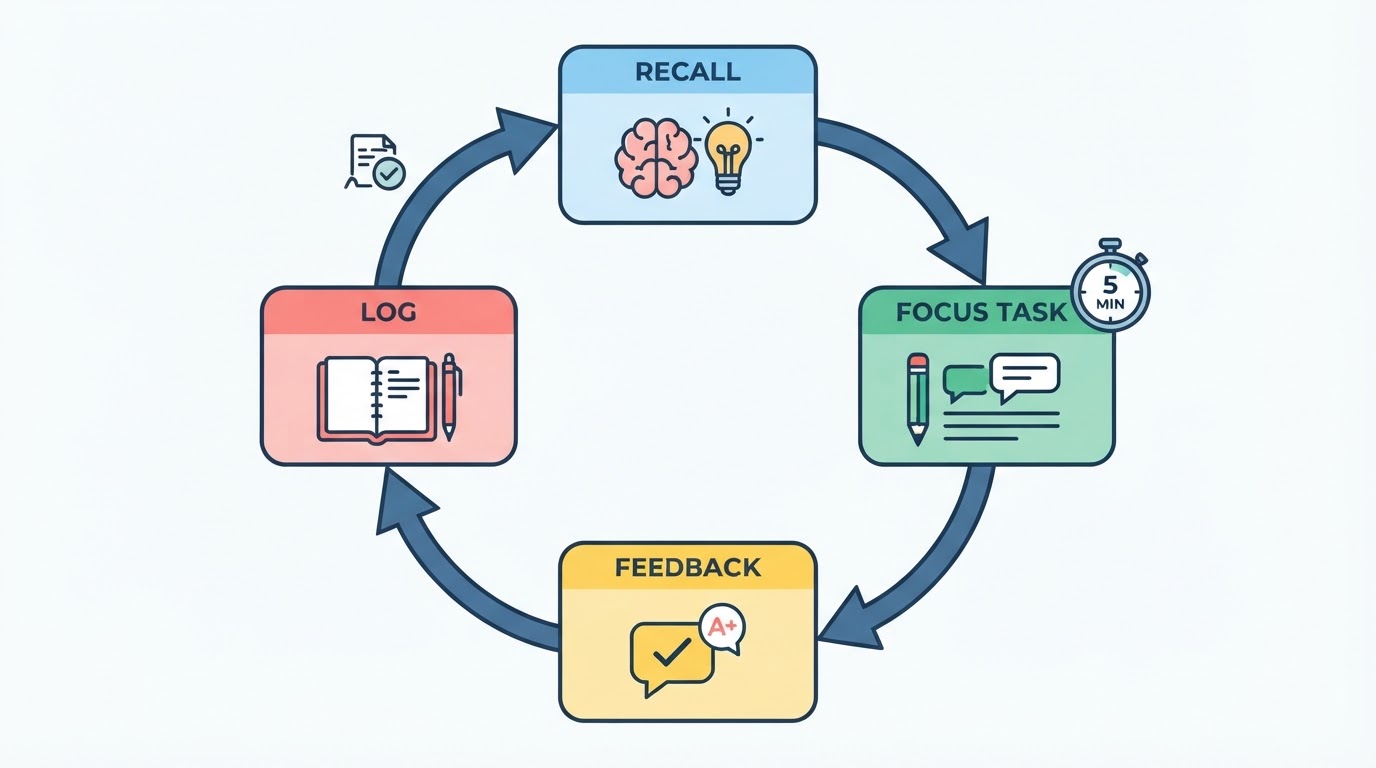
A Five-Minute Daily Loop You Can Keep
Most self-study plans fail because they ask for an hour that never arrives. This loop needs five minutes and one sentence you wrote yourself.
Step 1: Ask About Something You Already Wrote
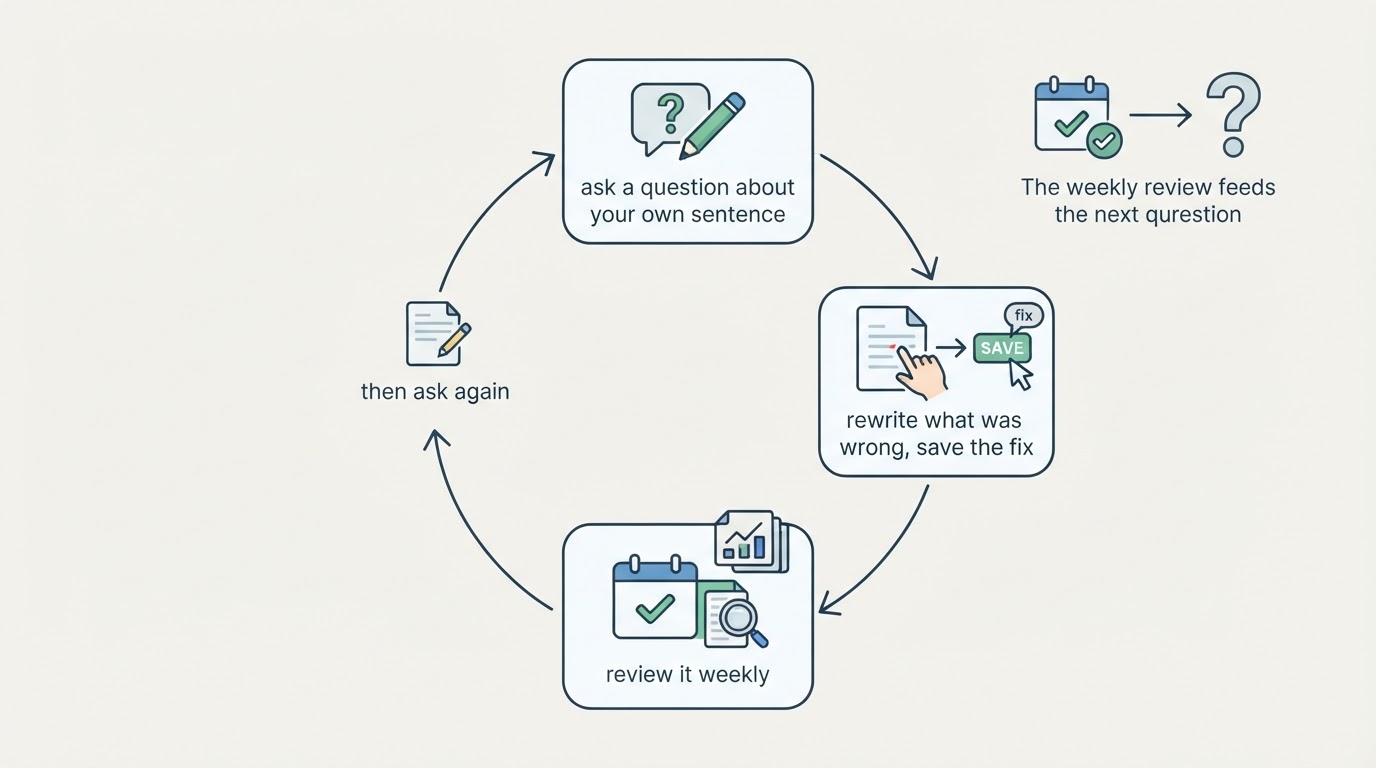
Start with a sentence you produced yesterday, even a clumsy one. Ask why a specific word, ending, or order is there. If you cannot find a question in your own writing, copy one line from your reading and ask about the choice it makes.
Step 2: Write Before You Ask for a Verdict
Write three sentences that use the pattern, then ask whether each one is correct. Writing first exposes the part of the rule you have not understood; asking first only tests your reading.

Step 3: Rewrite Only What Changed
Compare your sentence with the corrected version and change only the words that were wrong. A full rewrite hides which rule you missed, and the same mistake returns next week.
Step 4: Keep a Fix File
Keep one file with one line per day: the pattern, your wrong version, and the fixed version. This is the raw material for the weekly review, and it takes less than a minute to maintain.
The loop is deliberately small: one question about your own language, one rewrite, one saved fix. Small enough to finish on a commute, specific enough that you can see what changed.
Five minutes buys accuracy on a narrow point. It will not build listening stamina or speaking fluency by itself, so keep longer reading, listening, and speaking blocks elsewhere in your week and let this loop handle the questions they generate.
Day | Five-minute task | What you keep |
|---|---|---|
Monday | Read one short passage and ask about three things you could not explain | Three answered questions |
Tuesday | Rewrite Monday's sentences using those answers | Three corrected sentences |
Wednesday | Read your corrected sentences aloud and compare the recording | One pronunciation note |
Thursday | Free-write five sentences about your day and ask for corrections | A short corrected paragraph |
Friday | Redo the week's fixes without looking at your notes | A list of patterns that did not stick |
Weekend | Run the twenty-minute review | Next week's question list |
The Twenty-Minute Weekly Review
Run the twenty-minute review on the same day each week and keep the question list next to your fix file. Three checks, in this order:

- Can you produce the week's fixed patterns without looking at your notes?
- Which question types keep coming back?
- What will you ask about next week?
If a pattern survives all three checks, retire it from the fix file. If it fails the first check, it opens next week's loop. Twenty minutes is enough because the daily loop already did the sorting.
How to Judge a Free AI Language Assistant
Cost is the easy part of the decision; fit is the hard part. Five questions separate the tools that support a routine from the ones that interrupt it.
- Does the help live inside the lesson, or in a separate chat that forgets your material?
- Is the assistant part of the free tier, or a monthly upgrade that appears after you have invested a week?
- Is there a level structure, such as CEFR, that tells you what to study next?
- If you practice speaking, do you get feedback on individual sentences rather than a single score?
- Can you see what you asked and fixed last month?
MANA Learn is one example that answers several of these openly. Its public materials describe an AI Tutor that explains words, sentences, and grammar on demand while you study, and the company lists that tutor as part of the free experience rather than a paid upgrade. That combination of in-lesson explanations and free access is exactly the shape the five questions are looking for, though one strong feature is a component of a routine, not the routine itself.
This guide is published by the team behind MANA Learn, so weigh that when you compare options.
Four Habits That Stall Self-Study
Translating instead of explaining. Asking "what does this mean" ends the question. Asking "why this form here" starts a rule you can reuse.
Accepting an answer without producing language. An explanation you have not used is a note you have not taken. Write one sentence with it before you close the tab.
Tool-hopping. A learner who tests five assistants learns five interfaces and no rules. Pick one, run the loop for two weeks, then judge it on results.
Keeping no record of mistakes. Without a fix file, the same pattern returns in month three without its history. One line a day prevents that.
FAQ
Can an AI assistant replace a teacher or a class?
No. It can explain a rule faster than you can find it in an index, but it does not design a semester around your goals or judge your register against a real audience. If you already have a class or a tutor, use the assistant for the grammar questions so the expensive minutes go to speech and feedback.
How do I check whether an explanation is correct?
Ask for the rule, one example, and one exception, then test all three against your course material or a dictionary. If the answer changes when you rephrase the question, the explanation is probably thin; ask again with a narrower question.
What if the answers feel too advanced?
Say what level you are at and ask for the same explanation again. A useful request is to explain the pattern as if you had just finished A2. If the tool cannot adjust, that is a fit problem rather than a learning problem.
How much time per day is enough?
Five focused minutes that include a rewrite beat thirty passive minutes. Frequency compounds the fix file, and the weekly review is what turns the file into progress. When you have more time, spend it on listening and speaking rather than on more grammar questions.
The Takeaway
Pick one pattern you keep meeting. Ask about it tomorrow with a sentence you wrote yourself, rewrite only what was wrong, and save the fix. Do that for five days, run the twenty-minute review, and let the patterns that survive lead next week. The assistant is not the routine; it is the part that answers back while you practice.