What "free" usually means in an AI English app
Nearly every AI English app advertises a free plan. The word rarely means the same thing twice, and the difference decides whether you are looking at a durable daily habit or a longer demo.
Most free tiers you will meet follow one of three patterns:
- A permanently free core. The main learning loop stays free, and paid plans add extras such as deeper reports or offline access.
- A time-limited trial. Everything unlocks for a few days, then most AI features disappear.
- A metered free tier. AI help exists, but a daily quota caps messages, lessons, or speaking minutes.
None of these patterns is dishonest by itself. The problem starts when a marketing page promises the first pattern and the product delivers the second. For a budget-conscious learner, that gap is the whole decision: you are not choosing between an app and a paid course, you are choosing whether the free boundary covers the practice you actually need.
That is why the checks below focus on behaviour rather than labels. A word like "free" tells you nothing until you know which features stay open after the trial period ends, how much of a lesson you can finish without paying, and whether the app still helps you after your first week of use.
The five checks that decide free-tier value
Work through these in order. Each one takes a single session, so the whole test fits inside a week, and each one produces a pass or fail you can write down.
1. Does the AI stay free after the first session?
Open the feature you actually came for — conversation practice, grammar explanations, pronunciation feedback — and use it the way a normal learner would. Close the app. Come back the next day and look again.
- Pass: the same feature opens again without a payment screen.
- Fail: the app announces that the free trial has ended, or the feature is now labelled as a premium benefit.
If AI help is the reason you chose the app, this check outweighs every other item on the list.
2. Can you finish a full lesson loop without paying?
A lesson loop is more than a single exercise. It starts with new material, moves into practice, and ends with a result you can inspect: a score, a corrected sentence, a completed unit.
- Pass: you can start, practise, and finish that loop inside the free tier.
- Fail: the app walks you to the final step and then asks for a subscription to see the result or continue.
An app that stops short of the result still hands you content, but it never lets you see whether the content worked.
3. Does the free tier cover all four skills?
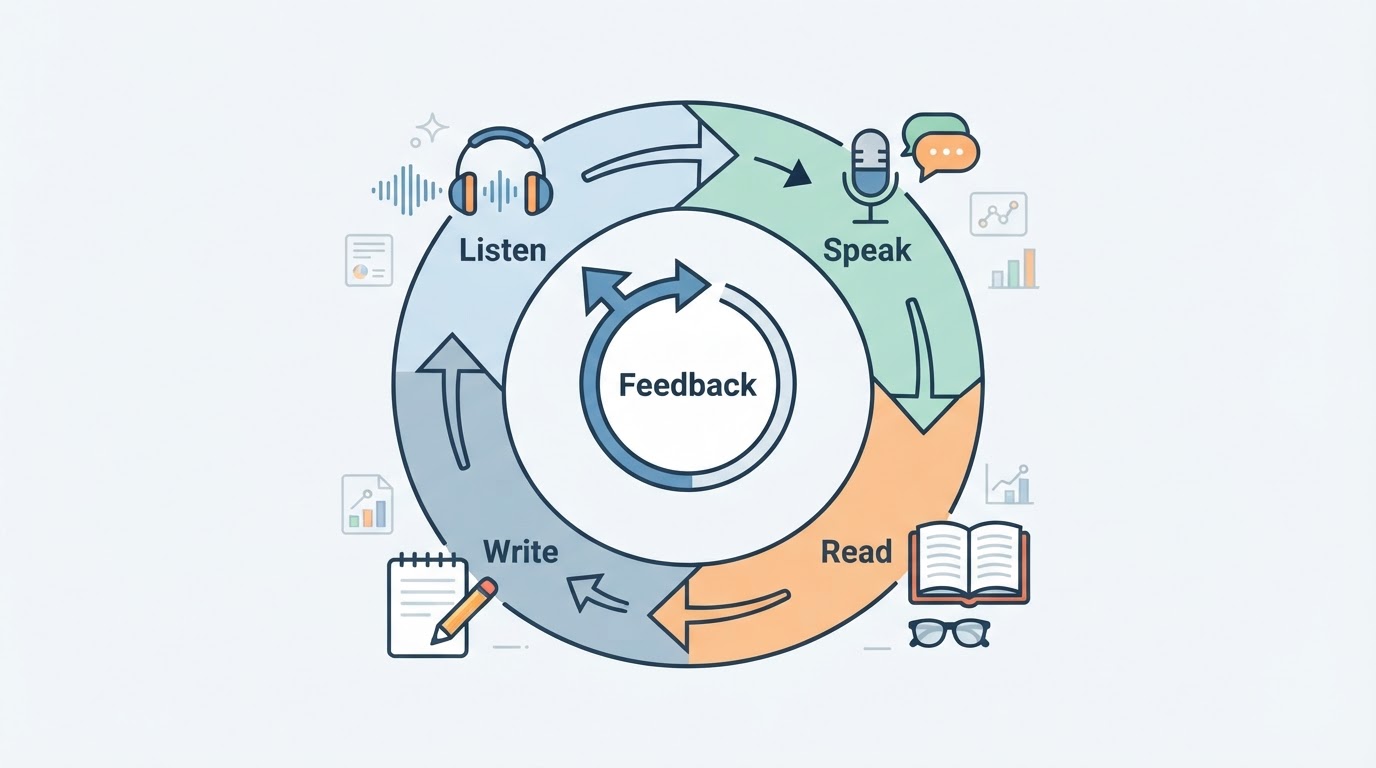
Listening, speaking, reading, and writing reinforce one another. An app that trains only one of them leaves gaps that are hard to notice until you try to hold a conversation.
Look for a free path that lets you listen to a short passage, speak a few sentences aloud, read something at your level, and write a response. If speaking practice sits behind a paywall, reading and listening can still improve, but you will need another tool for pronunciation and fluency.
4. Does the practice fit a three-to-five-minute day?
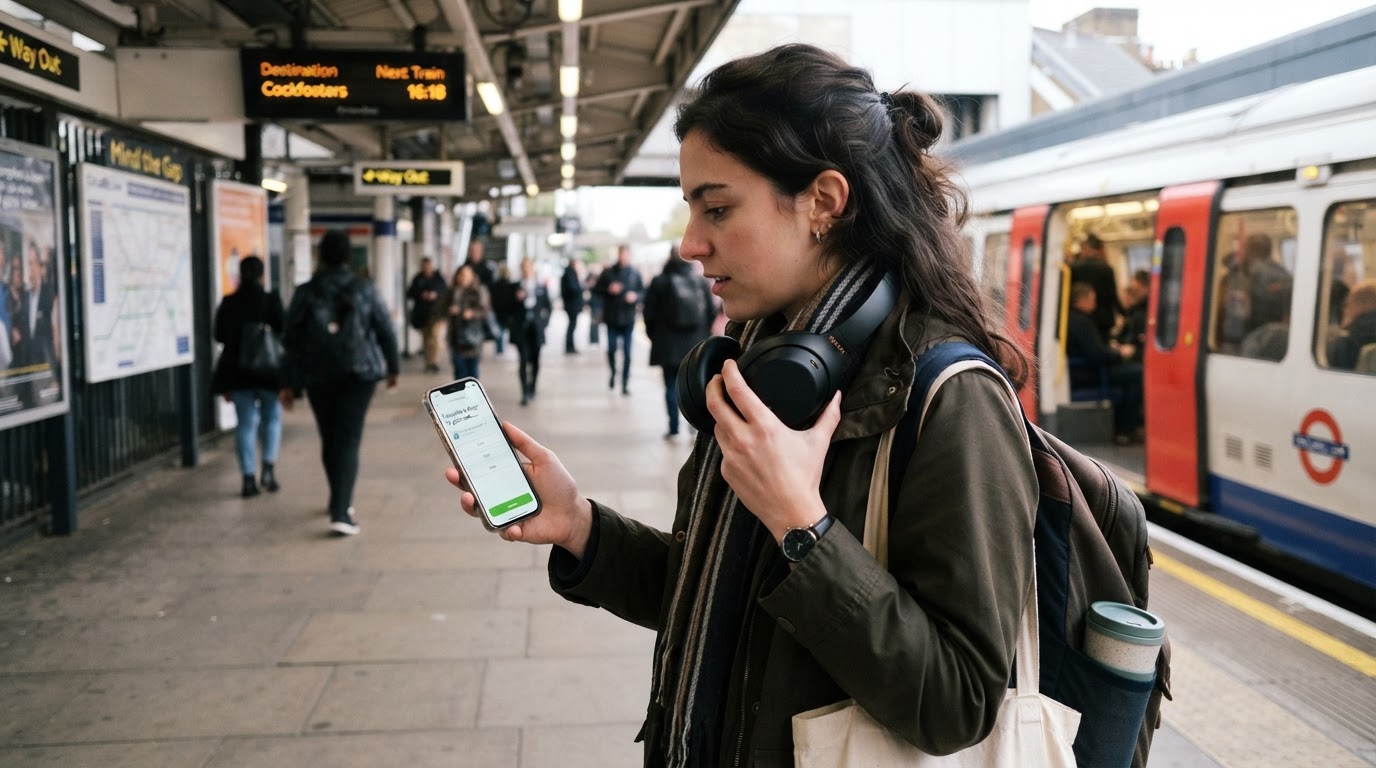
Short daily sessions are easier to keep than long study blocks, especially for busy professionals and students with coursework of their own. This check is mechanical: set a timer, start a normal session, and see what one sitting really contains.

- Pass: you complete one meaningful unit of practice inside your available break.
- Fail: long intros, advertisements, or setup screens consume the session before any practice happens.
5. Does it help you review what you got wrong?
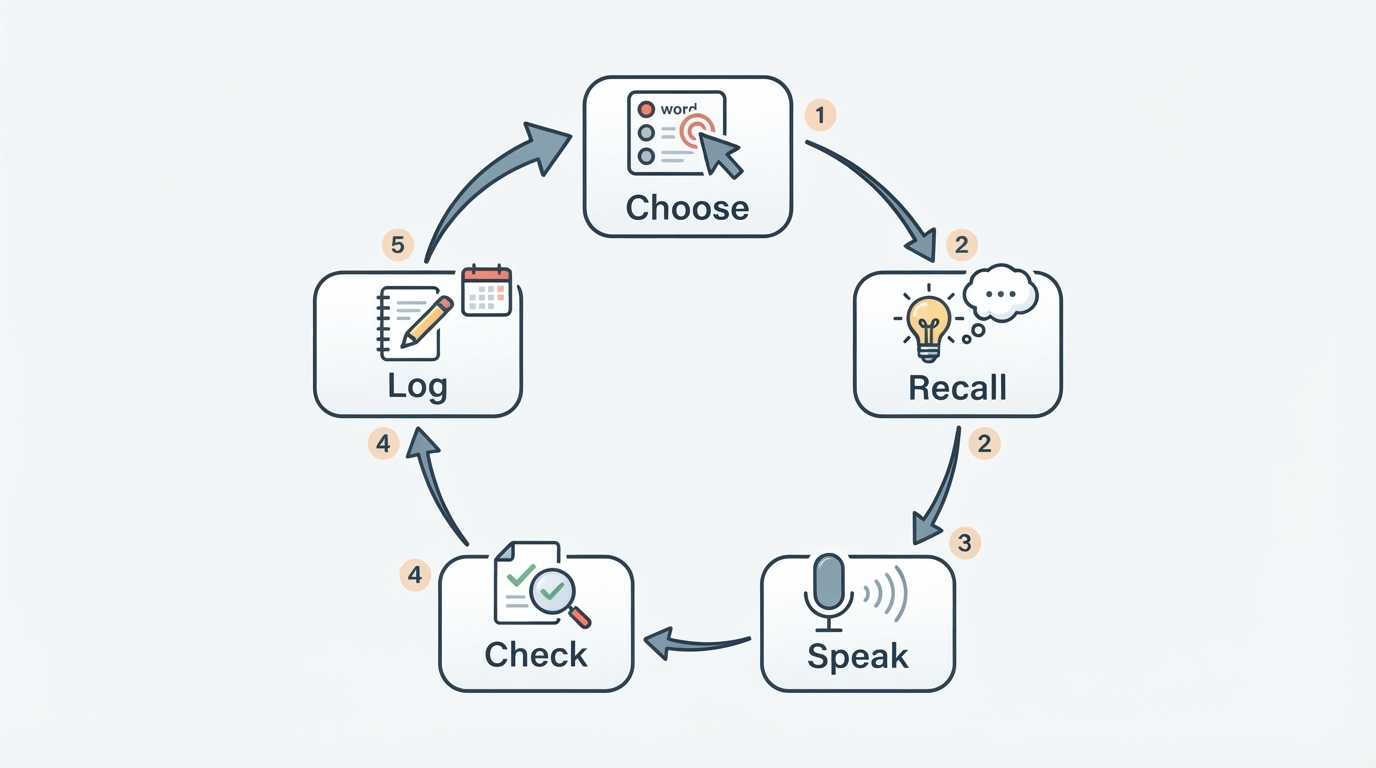
Your mistakes are the most useful data you produce while learning. A free tier that collects wrong answers and lets you revisit them turns a short session into a loop that compounds; a free tier that hides review keeps you repeating the same errors.
- Pass: the app stores your mistakes and lets you redo them at no cost.
- Fail: review is a premium feature, or errors disappear when a session ends.
A seven-day test plan before you commit
Run the table below like a checklist. Each row takes one normal session, and the last row is the only one that matters in the end.
Day | What to do | What counts as a pass |
|---|---|---|
1 | Install the app and finish onboarding without entering payment details. | You reach a lesson instead of a paywall. |
2 | Ask the AI to explain something you genuinely do not understand. | The answer addresses your sentence, not a generic definition. |
3 | Record yourself speaking and read the feedback. | You receive a correction or score you can act on. |
4 | Read a short passage and write two or three sentences. | Both tasks are available on the free tier. |
5 | Take the shortest possible session and time it. | It fits inside a five-minute break. |
6 | Open the review area for earlier mistakes. | Old errors are still there and can be redone. |
7 | Count how many days you actually opened the app. | Four or more sessions, with no payment. |
By day seven the answer should be obvious: would you still open this app next week if nothing new were promised to you?
What a free tier that holds up looks like
MANA Learn, a free AI language-learning app, is one example to test against the same checklist. Its published feature list describes an AI tutor that explains vocabulary, sentence structure, and grammar in context, and it presents that tutor as available on all tiers rather than locked behind a paywall.
Felo product screenshot.
That distinction is exactly what checks one and five are built to catch. When the explanation layer stays free, a beginner who meets an unfamiliar grammar pattern can ask about it in the moment instead of waiting for an upgrade, and a learner with a question in the middle of a lesson can get an answer without switching tools.
Product pages do their own marketing, so treat any claim you read, including this one, as a hypothesis to verify during the seven-day test. That is the point of testing before you commit.
Where free tiers still fall short
- No substitute for real conversation. AI feedback can correct sentences and pronunciation, but it cannot fully replace the improvisation and cultural context of talking with another person. Use the free tier to build the habit, and add human practice where you can.
- Terms change. Features move between free and paid tiers over time. Re-run the checklist after a major update instead of assuming last month's answer still holds.
- Speaking practice depends on your environment. Microphone quality and background noise affect any speech-based feedback, so test that feature somewhere quiet before you judge it.
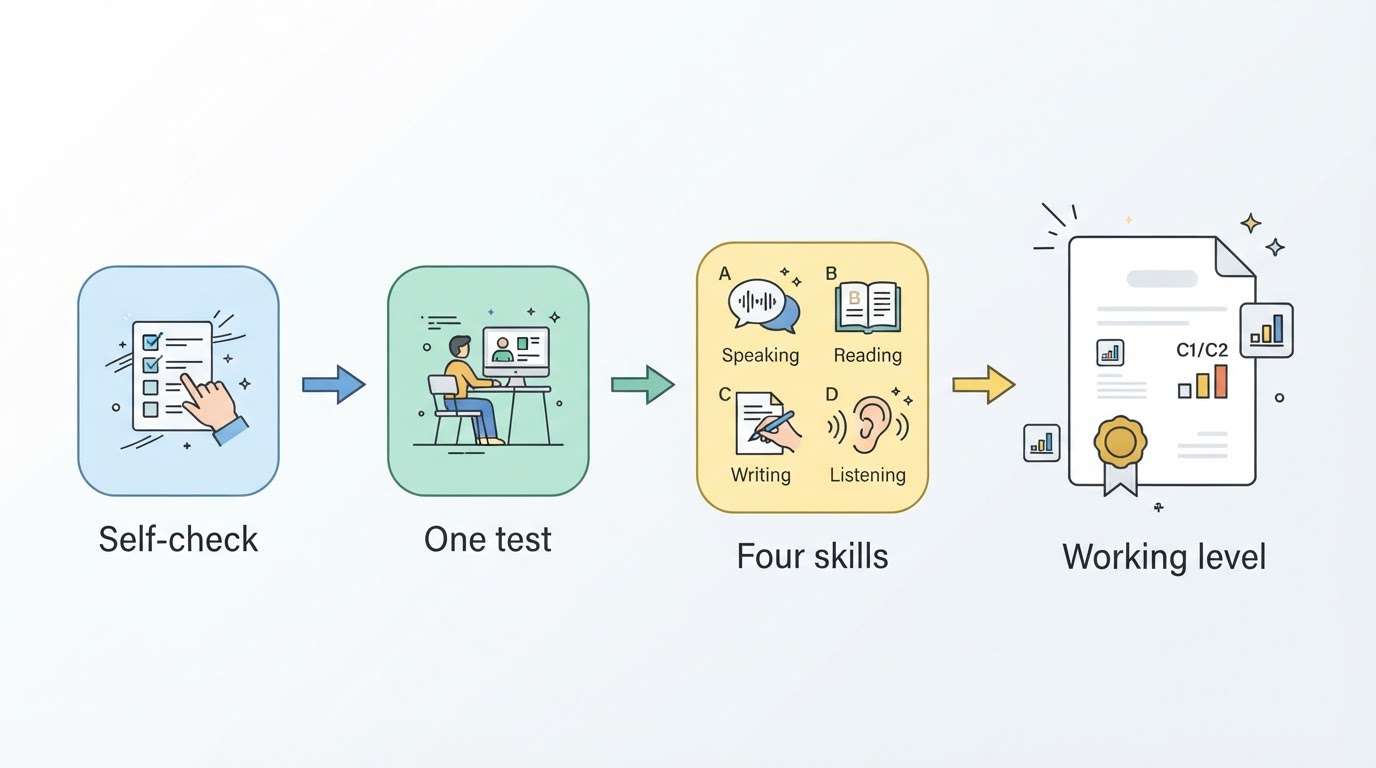
- Credentials are a separate question. If your goal is an exam result or a formal certificate, check that requirement on its own. A consumer learning app and a certification body are not the same thing.
Next steps
- Shortlist two or three apps and ignore their feature pages for now.
- Run the seven-day test on the one you would most likely keep.
- Score each of the five checks: pass, partial, or fail.
- Commit only if the AI features you care about passed check one and you logged at least four sessions.
- Set a reminder to re-test in a month, when the novelty has worn off.
FAQ
Is a free AI English app enough to become fluent?
Fluent is a demanding target, and no single app carries the whole load. A strong free tier can cover daily practice in listening, reading, and writing, plus a large share of speaking drills. Real conversations and longer, unstructured practice still decide how comfortable you become.
Do I have to create an account to test a free tier?
Treat the signup step as a variable, not a rule. Some apps let you try a lesson first; others ask for an email before any content loads. Either way, hold back payment details during the test week so the pass and fail conditions stay honest.
How long does a free tier have to last to count as free?
Longer than the test, at minimum. A tier that survives a week but expires on day ten behaves like a trial with extra steps. The useful standard is simple: if you can still complete the five checks on day thirty, the free tier is doing real work for you.
What if the free tier changes after I commit?
Re-run the checklist rather than abandoning the habit. If check one fails after an update, compare the alternatives on your shortlist against the same five criteria before switching, and keep the session routine you have already built.
Takeaway
The best free app to learn English with AI is not the one with the longest feature list. It is the one whose AI features are still available on day thirty, whose lessons close the loop without a payment screen, and whose daily session fits the time you actually have. Test before you commit, and the free tier stops being a gamble.