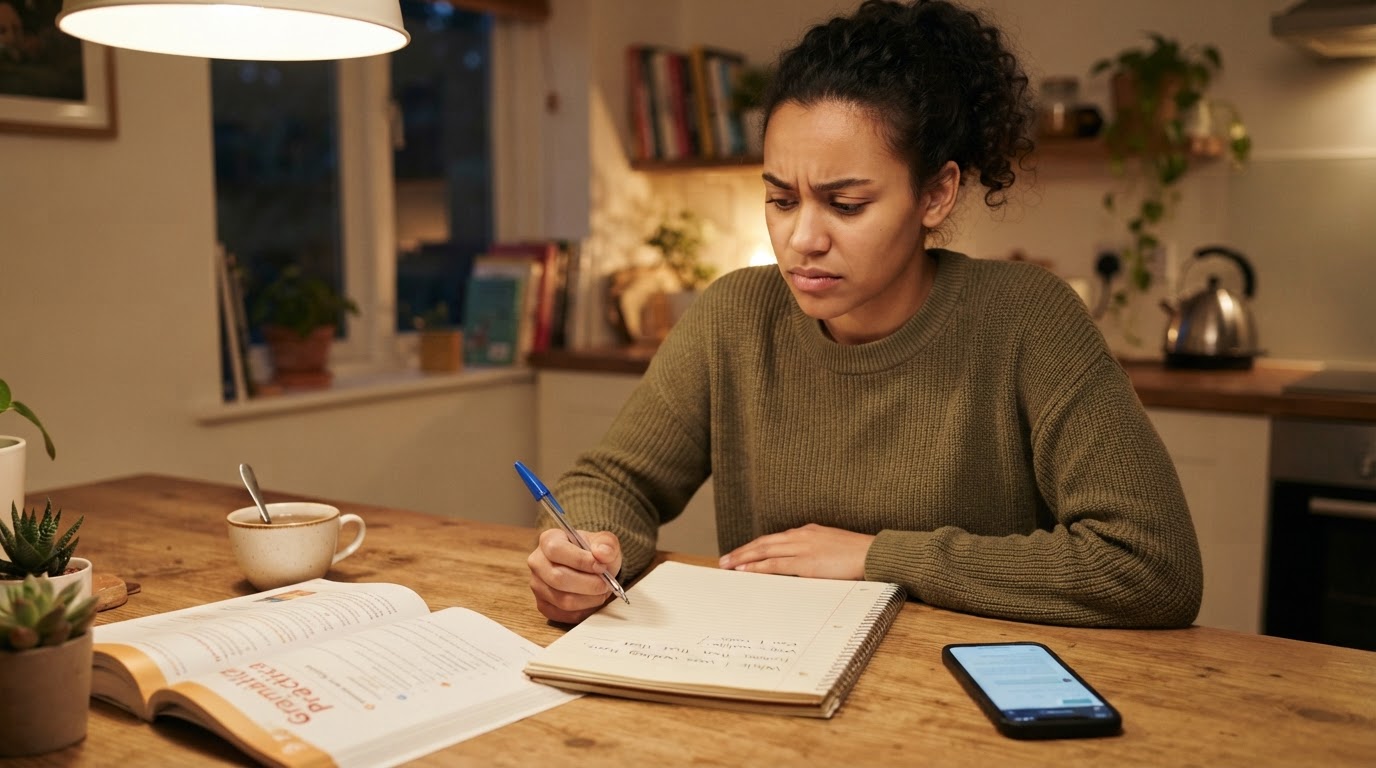
Why short daily sessions beat occasional marathon study
Most learners do not quit because the material is too hard. They quit because the plan is too large. A two-hour weekend session feels productive, but by the next weekend the details you "learned" have faded, and restarting feels like starting over.
Short daily practice flips that pattern. When you touch the language every day, each session begins by reactivating yesterday's material, so review is built into the routine instead of treated as an extra chore. The work is smaller but it happens far more often, and frequency is what keeps vocabulary, patterns, and pronunciation available when you need them.
There is a second reason to keep sessions short: correction quality. In a long session you tend to batch your mistakes and fix them later, if at all. In a five-minute session you can check every attempt while the reasoning behind it is still fresh, which makes the correction stick to the exact moment it applies.
The practical implication is simple: pick a session length you can sustain on a bad day, not a good one. Five minutes is enough to recall a handful of items, say a few sentences out loud, and correct one recurring mistake. If you have more time, add a second round rather than extending the first one to exhaustion.
The five-step daily practice loop
A repeatable loop removes the daily decision about what to study. Five steps are enough.
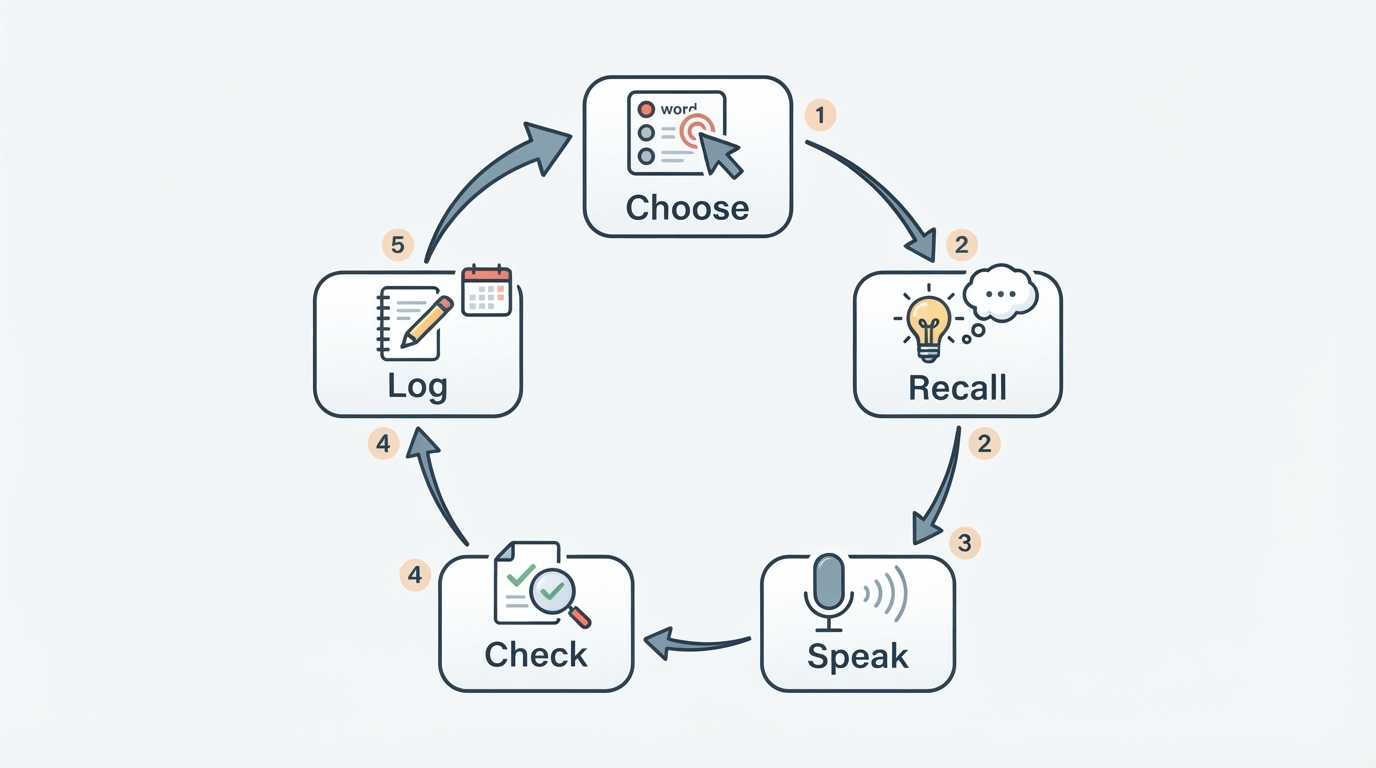
- Choose one target. Select a single focus for the session: ten words from yesterday, one grammar pattern, or one short dialogue. One target keeps the session finishable.
- Recall before you review. Close your notes and try to retrieve the target from memory first. Attempting recall — even when it fails — makes the following review more effective than reading the list again.
- Produce output out loud. Say or read the material aloud. Speaking exposes pronunciation and word-order problems that silent reading hides, and it takes only a minute.
- Get feedback immediately. Check your attempt and correct the specific error you made. Immediate correction is the point of a short session: it stops a wrong form from being practiced into habit.
- Log it and stop. Write one line about what you practiced and what you got wrong, then close the app. Stopping on time is what makes tomorrow's session possible.
Run the loop in the same order every day for the first month. The order matters less than the repetition, but a fixed sequence means you never spend the session deciding what to do next.
How to make a daily language practice habit stick
Motivation is unreliable; structure is not. Build the habit around decisions you only have to make once.
Anchor the session to an existing routine. Attach practice to something you already do every day — the first cup of coffee, the commute, brushing your teeth at night. The established habit becomes the reminder.

Define a minimum viable session. Write down the smallest version that still counts: two minutes, five items, one spoken sentence. On difficult days you complete the minimum; on good days you continue. The floor protects the streak of repetitions that actually builds skill.
Remove friction. Open the lesson the night before, download the audio, or keep a single browser tab ready. Every extra step between intention and practice is a place where the routine dies.
Track completion, not duration. A simple checkmark calendar is enough. You are training the behavior of showing up, and a visible chain of completed sessions is more motivating than a timer.
Plan for missed days. Decide in advance that one missed day is noise and two in a row is a signal. After a missed day, run the minimum session — do not "make up" the lost time with a double session, which usually ends the habit instead.
A sample weekly routine
The table below spreads practice across the skills a daily routine should touch, while keeping every session inside five to ten minutes.
Day | Five-minute focus | What you produce |
|---|---|---|
Monday | Shadow a short dialogue | Read the dialogue aloud twice, matching the rhythm |
Tuesday | Recall Monday's items from memory | Write or say ten items without looking |
Wednesday | Pronunciation drill | Record one paragraph and compare it with the model |
Thursday | Read a short text aloud | One paragraph, out loud, with unknown words marked |
Friday | Produce three sentences | Write three original sentences and get them corrected |
Saturday | Answer questions about your week | Speak five answers using the week's target pattern |
Sunday | Review the week's mistakes | List three recurring errors and choose next week's target |
Two rules keep the schedule honest. First, the "what you produce" column is the session's output — if you only read or listened, the session is not finished. Second, the Sunday review decides Monday's target, so the loop closes and the next week starts with a purpose.
What to look for in a free practice app
Free tools are not interchangeable, and the differences that matter are the ones that support a daily loop rather than the ones that look impressive in a feature list.
- Feedback inside the free tier. An app is only useful for daily practice if its corrections, explanations, and progress tracking are not locked behind a paywall. Check this on day one, before you build a routine around it.
- A visible level framework. A path built on a recognized scale — the Common European Framework of Reference (CEFR), for example — shows you where you are and what "next" means.
- Pronunciation feedback. Speech feedback turns reading aloud into a measured exercise instead of an unverified guess.
- Explanations you can act on. When you get something wrong, the app should tell you why, in terms you can apply to the next attempt.
- A short default session. If the app's basic lesson takes thirty minutes, it fights your routine instead of supporting it.
Value comparison is worth doing deliberately: list what each candidate includes for free, then check whether the items you actually use — feedback, review, and speaking practice — are in that free set. A generous catalog of paid features is worth less to a daily learner than reliable free feedback.
One example of the progression criterion in practice: MANA Learn's CEFR-aligned courses run from A1 to C2, cover listening, speaking, reading, and writing, and adapt lesson sequencing as your progress changes. That combination — a clear level path plus adaptation to individual progress — is the kind of structure that keeps a five-minute session pointed at the next skill instead of repeating what you already know.
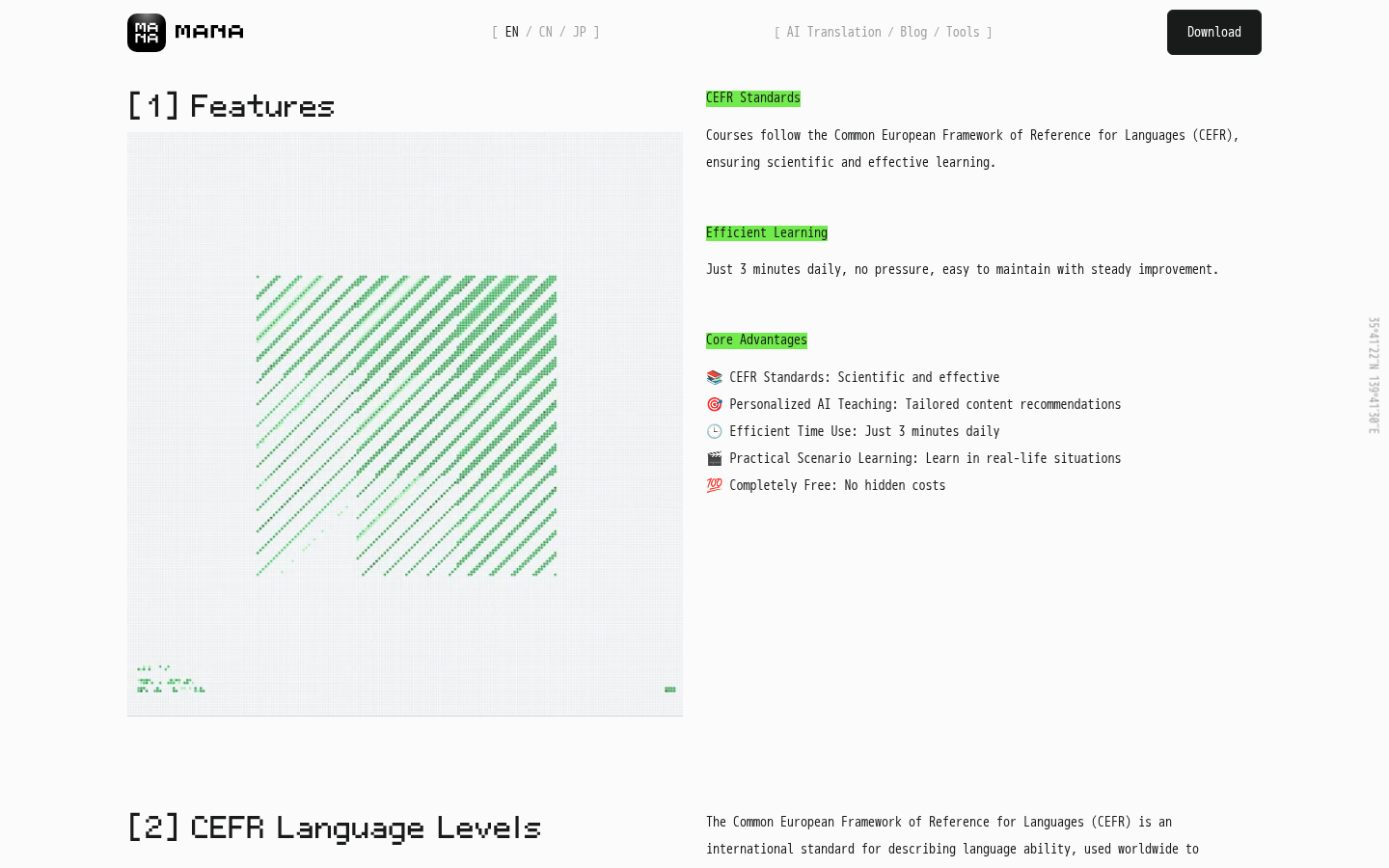
Felo product screenshot.
Common mistakes that break the routine
Practicing for too long. Sessions that need a free evening get skipped. Keep the default short and let extra time be optional.
Consuming without producing. Watching a video or rereading a list feels like practice but provides no test of retrieval. Every session should end with something you said or wrote.
Reviewing without spacing. Repeating today's items in one block is less useful than meeting the same items again tomorrow and next week. Let the loop handle the spacing.
Ignoring recurring errors. A mistake that appears three times is a target, not an accident. Log it and make it the focus of a session.
Switching tools every week. Each app has its own sequence, so switching restarts your progress display and interrupts the review schedule. Choose once, then re-evaluate monthly.
FAQ
How long should daily language practice be?
Five to fifteen minutes is enough for a habit that survives a busy week. The minimum matters more than the average; a consistent short session built over months outperforms irregular long sessions.
What should I do if I miss a day?
Resume the next day with the minimum session. Do not double the length to catch up. A single missed day does not undo your progress, but an all-or-nothing recovery plan often ends the routine.
Can I practice speaking without a partner?
Yes. Shadowing, reading aloud, and recording yourself all produce speech you can compare against a model. The key is to speak and then check, rather than to speak without feedback.
Do I need a paid subscription to make progress?
Not necessarily. A free tier with corrections, a review mechanism, and speaking feedback covers the core loop. Pay for a subscription only when you can name the specific capability you need and the free tier lacks it.
How do I remember what I practice?
Return to each item at increasing intervals: tomorrow, later in the week, and at the Sunday review. The recall attempt itself is what strengthens memory, so always try to retrieve before you look at the answer.
Takeaway
Daily language practice is a design problem more than a willpower problem. Choose a session you can finish in five minutes, run one loop — choose, recall, speak, check, log — and let a weekly review decide what comes next. Pick tools that put feedback and review in the free tier, anchor the session to something you already do, and measure whether you showed up rather than how long you sat there. Do that for a month, and the routine stops being a decision.