What an AI-Powered Language Learning App Changes
Most language apps built their reputation on repetition. You tap through flashcards, keep a streak alive, and trust that enough repetitions will eventually stick. AI changes that model in three practical ways.
Correction gets faster. An AI layer can evaluate what you actually produced, including spoken input, instead of checking whether you picked the right multiple-choice option. Sequencing gets adaptive, so the app can reorder what you see next based on the mistakes you just made rather than marching everyone through a fixed unit. Explanations become available on demand, which means you can ask why a form is used instead of re-reading a rule written for a general audience.
None of this removes the need for deliberate practice. It removes some of the guesswork about what to practice next.
The Four Skills in One Short Session
A well-designed daily loop touches all four channels of language use, even when the session is only a few minutes long.
- Listening builds your ear for natural speed and intonation before you try to imitate it.
- Speaking forces retrieval. Producing a sentence is harder than recognizing one, and pronunciation feedback only exists if you actually talk.
- Reading exposes you to sentence structures you have not used yet.
- Writing slows the process down enough to notice grammar you would otherwise skim past.
Apps differ in how much weight they give each skill. Some treat speaking as an optional extra, while others build pronunciation scoring into the core lesson flow. That difference matters more than the length of the vocabulary list.
How a 3–5 Minute Daily Session Works
Short sessions work because they lower the cost of starting. A five-minute commitment survives a busy Tuesday in a way that a forty-minute study block rarely does. The catch is that short sessions need a tighter structure than long ones, because there is no room for drifting.

A useful session moves through four phases: recall what is fading, meet something new, produce language yourself, then push mistakes back into the review queue.
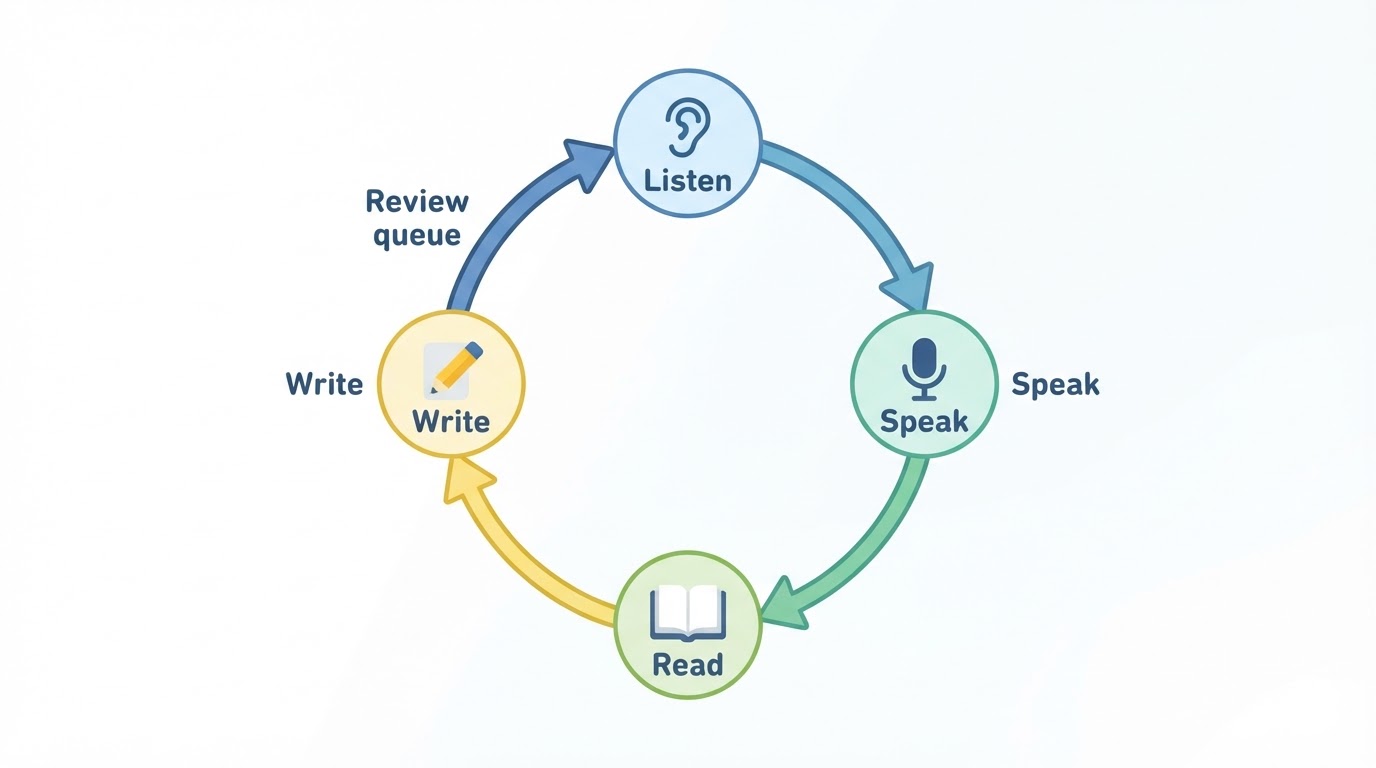
A Sample Five-Minute Session
- 30 seconds — recall. Re-answer three items you missed yesterday. This is retrieval, not review reading.
- 90 seconds — new material. Work through one short dialogue or grammar pattern at your current level.
- 90 seconds — speak aloud. Read or respond out loud, and let the app score your pronunciation.
- 60 seconds — write. Produce one or two original sentences using the pattern you just met.
- 30 seconds — queue. Anything you got wrong returns to tomorrow's recall block.
What Counts as Done
A session is complete when you produced language, not when you recognized it. Three checkpoints keep that honest: at least one spoken attempt, at least one original written sentence, and at least one mistake logged for later. If a session ends with nothing but correct multiple-choice taps, you have maintained a streak without building production skill.
What to Check Before You Commit
App store listings describe features, not learning design. These six checks push past the marketing language.
Check | Why it matters | What good looks like |
|---|---|---|
Progression framework | A named scale tells you what "level" means | Levels mapped to a public standard such as CEFR A1–C2 |
Skill coverage | Sessions that ignore production feel easy but stall | Every session reaches listening, speaking, reading, and writing |
Speaking feedback | Pronunciation needs external judgment | Recorded attempts receive specific, repeatable feedback |
Explanations | Rules you cannot question are rules you forget | You can ask why a form is used and get an answer in context |
Review mechanics | Unreviewed mistakes come back as habits | Wrong answers return on a schedule, not just once |
Free-tier boundary | The features you care about may sit behind payment | You can name exactly which AI features are free before you start |
Run the checks against the free version first. If a criterion only exists in the paid tier, treat it as a subscription cost rather than a free feature.
Free or Paid? Settle the Value Question First
The word "free" means different things across language apps. Some offer unlimited drills but charge for AI explanations. Others limit how many lessons you can take per day. A few keep pronunciation scoring entirely in the paid tier.
Before you pay, answer four questions:
- Which AI features are included at no cost, and which ones trigger an upgrade prompt?
- Is there a daily cap on lessons, practice time, or speaking attempts?
- Does the free tier include any way to measure your level, or is placement testing paid?
- What specifically do you get for the subscription: more content, better feedback, or simply fewer restrictions?
Then run a two-week test. Track how many sessions you actually finished, not how many you started. A paid plan you use daily costs less per hour than a free plan you abandon.
What a Structured Path Looks Like in Practice
MANA Learn describes its course path as aligned to the Common European Framework of Reference (CEFR), from A1 (Beginner) to C2 (Proficient). Its product description says the courses cover listening, speaking, reading, and writing across multiple language pairs, including Chinese–English, Japanese–English, Chinese–French, English–Japanese, and Japanese–Spanish, and that the AI adapts lesson sequencing as a learner progresses through the levels. The same description gives a concrete example of the range: an A1 learner works on basic phrases and self-introductions, while a B1 learner practices connected text on familiar topics. These are the vendor's own descriptions, so check the current app before relying on any specific detail.
Felo product screenshot.
The useful question is not which app wins on every criterion. It is whether the progression scale, skill coverage, and feedback loop match the way you actually study.
Where Short Daily Sessions Fall Short
Micro-sessions are a habit tool, and they have real limits.
- Total production time stays low. Five minutes a day works out to roughly two and a half hours a month, and only part of that is speaking. If conversational fluency is the goal, plan longer speaking blocks somewhere in the week.
- Recognition can masquerade as skill. Picking the right answer from four options feels like learning, but it does not require you to construct anything.
- Automated feedback has blind spots. Pronunciation scores and grammar suggestions are useful signals, not final judgments. Treat a low score as a prompt to listen again, not as a verdict.
- Adaptive difficulty can drift. If the app keeps adjusting without a periodic level check, you may settle into a comfortable band that never stretches you.
- Streaks punish honesty. Missing a day is normal. An app that makes you feel like a failure for it pushes you to protect the streak instead of the learning.
The fix is not to abandon short sessions. Keep the daily loop, add one longer session each week for extended speaking or writing, and re-check your level every month or two.
FAQ
Do I need a paid plan to get AI feedback?
Check the free tier directly. Look at whether explanations, pronunciation scoring, and adaptive difficulty are available without payment, and whether daily practice is capped. If the AI features you value all sit in the paid tier, compare that subscription against what a tutor would cost for the same number of speaking minutes.
How long before I notice progress?
Look at completed checkpoints rather than feelings. Count spoken attempts, original written sentences, and mistakes you recycled successfully. Those numbers move before fluency does, and they are a better guide to whether the routine is working.
Can five minutes a day replace a class or a tutor?
No. Short sessions build vocabulary, habit, and pattern recognition efficiently. Real conversation, especially under time pressure with another person, tests a different skill. Use the app daily and schedule live practice separately.
What should I do on a day I only have two minutes?
Run recall only. Re-answer five items you have missed before, then stop. You keep the habit and the memory work intact, and you avoid the crash that comes from an all-or-nothing routine.
Takeaway
An AI-powered language learning app is at its best when it compresses a full practice loop into a few spare minutes: recall, new input, spoken and written production, and a review queue that catches mistakes before they harden. Judge any app by whether its free tier delivers that loop, whether its progression follows a standard you can verify, and whether you can add longer speaking sessions when fluency, rather than habit, becomes the goal.