What sentence analysis with an AI tutor actually means
Sentence analysis is the habit of taking one real sentence apart and answering four questions:
- Structure. Where are the clauses, and which one carries the main idea?
- Grammar. What job does each verb form, pronoun, or connector do?
- Meaning. How do the parts combine, and what changes if you move or remove one?
- Usage. Is this phrasing natural for the situation, the register, and the dialect?
A dictionary tells you what a word means. An AI tutor can tell you what a word is doing in your sentence, and why the alternative you had in mind sounds slightly off. That is the real value: explanation on demand, bound to the sentence you actually wrote or read, at the moment the question is still interesting.
The loop that makes it work
Explanation alone rarely sticks. The pattern that does is:
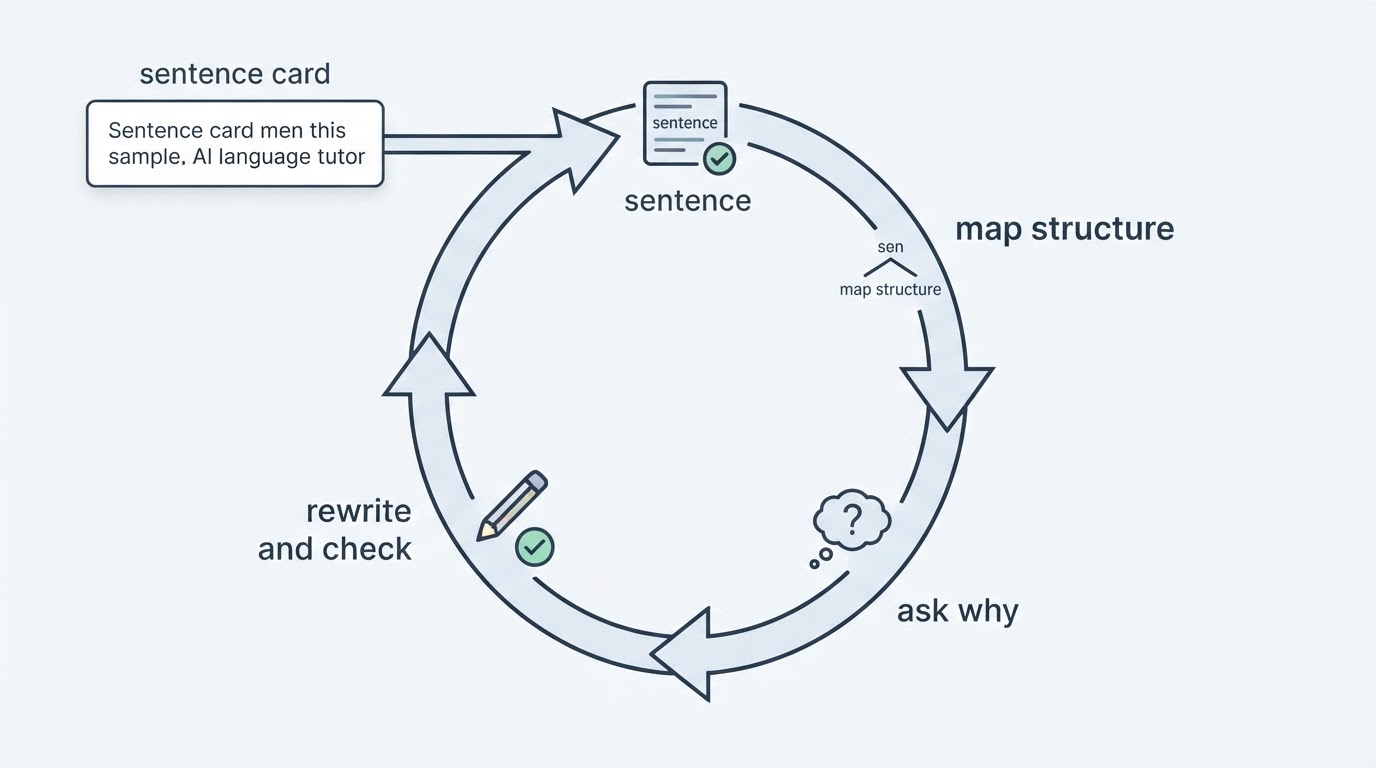
- Bring a real sentence.
- Ask for a structural map.
- Ask "why" about one choice.
- Rewrite the sentence yourself.
- Ask the tutor to check the rewrite.
Each step is small on purpose. The goal is not to finish a grammar chapter; it is to process one sentence well enough that the pattern becomes reusable.
How an AI language tutor for sentence analysis works
Systems differ in wording, but the order of analysis is usually predictable. Knowing the order lets you steer the conversation instead of accepting whatever comes back.
It looks at the whole sentence first
The tutor identifies clause boundaries, the main subject, and the finite verb, then separates subordinate or relative clauses from the main idea. A useful answer gives you a map rather than a translation: main clause plus dependent clause, with each chunk's function named.
It labels the parts and their jobs
Next comes the phrase level: verb forms (tense, aspect, voice, mood), noun phrases, modifiers, and connectors. A good explanation names the label and the effect. "The past perfect here puts the checking before the later event, so the sentence reads as a sequence rather than a list" tells you something a rule table cannot.
It connects grammar to meaning
This is where an AI tutor beats a static reference. It can say what a choice signals in context: certainty or hedging, formality or intimacy, emphasis or neutrality. Ask for that layer explicitly, because it is the layer that improves your own writing.
It offers alternatives and trade-offs
Request two or three rewrites and ask what each one gains or loses. Comparing versions teaches judgement, which is what fluency actually requires.
It adapts to your level
If an explanation is too abstract, ask for simpler wording and a shorter example. If it is too shallow, push harder: "Explain the difference the way a native speaker would feel it." The tutor's depth is largely set by the quality of your question.
A worked example: one sentence, five questions
Here is a sentence that rewards analysis:
Although the report had been checked twice, a few numbers were still wrong.
You can copy this question workflow with any sentence you meet.
# | What to ask | What you are training |
|---|---|---|
1 | "Break this sentence into clauses and label what each part does." | Seeing structure before vocabulary |
2 | "Why 'had been checked' and not 'was checked'?" | Tense, aspect, and sequence |
3 | "What changes if I write 'few numbers' instead of 'a few numbers'?" | Nuance and quantifiers |
4 | "Show me two rewrites a careful editor would accept." | Register and style control |
5 | "Now give me a similar sentence to analyze on my own." | Active recall |
What a strong answer should contain:
- A clause map. "Although..." sets up a concession: it grants one fact before the main clause reports something that still went wrong.
- A verb phrase explained in context. "Had been checked" is past perfect passive. The checking happened before the "still wrong" observation, and the person doing the checking is either unknown or unimportant.
- A quantifier distinction. "A few" means some, but not many. "Few" alone means not many, and it leans negative.
- Two or three rewrites with consequences. "The report had been checked twice, yet a few numbers were still wrong" is tighter. "A few numbers were still wrong even after two rounds of checking" foregrounds the failure.
- A transfer task. One new sentence with the same structure so you can run the analysis yourself.
If an answer feels vague, ask: "Which rule is this, and what would a reader understand if I chose the other form?" That one question turns a pleasant chat into precise instruction.
The self-check that closes the loop
Before you accept an explanation, restate it in one sentence of your own words, then write a new sentence that uses the pattern. If you cannot, the pattern is not yours yet. Ask a follow-up about the exact part that blocks you, and try again.
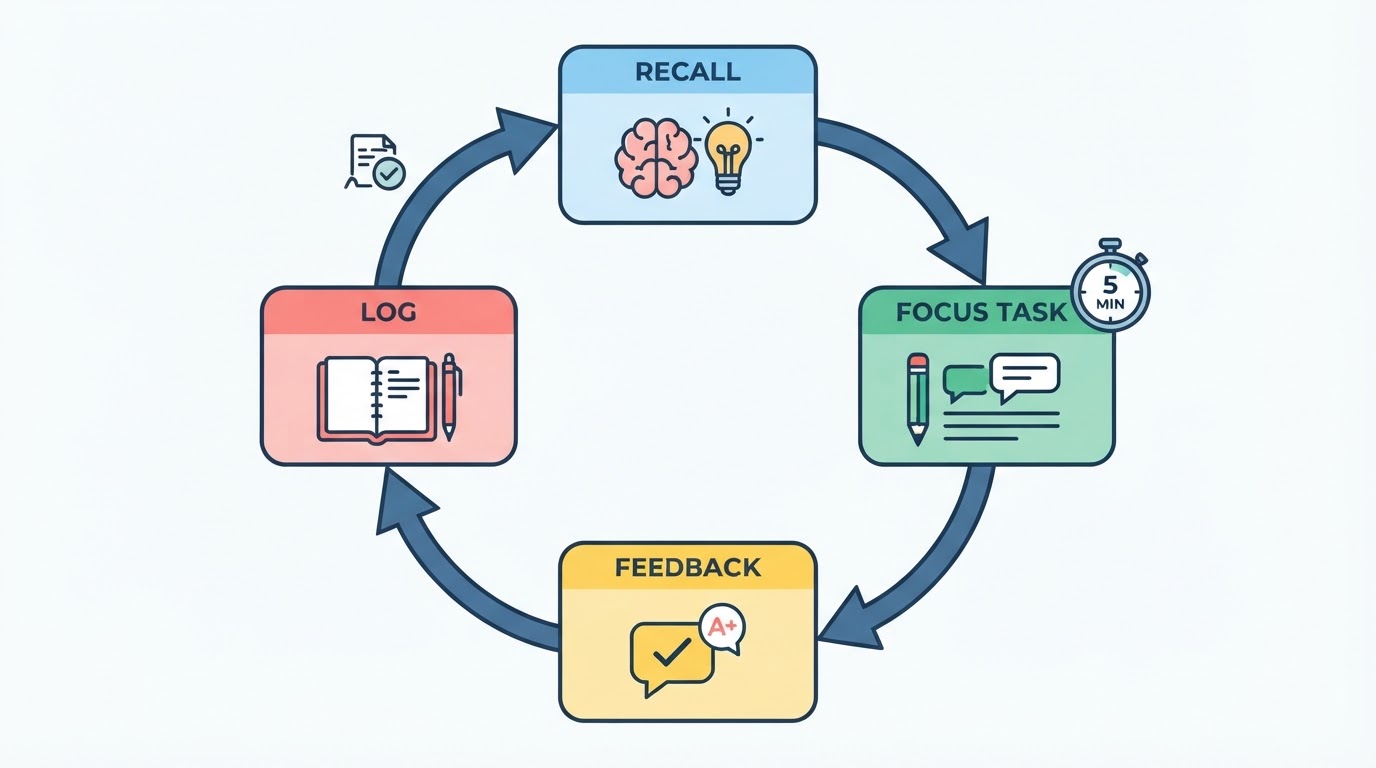
A routine that fits three to five minutes
Short sessions beat marathon grammar sessions because consistency builds pattern recognition, and the point is a habit, not a lecture. This routine fits a commute, a coffee break, or the minutes before a meeting.
- Minute 1: pick one sentence. Take it from an email, an article, a message, or your own draft. Real sentences carry real context.
- Minute 2: map it. Ask for clauses and the main verb before you ask for meaning.
- Minute 3: ask one "why." Choose the detail that surprised you most.
- Minute 4: rewrite it. Make it clearer, shorter, or more appropriate, then ask for a check.
- Minute 5: log the pattern. Write one line in a notes file: the pattern, the effect, your own example.
Signs the routine is working
- You start predicting the explanation before you read it.
- Your rewrites need fewer corrections than they did a month ago.
- You notice the pattern in new texts without being prompted.
- Your notes hold patterns and effects, not isolated vocabulary.
Study tips that raise the return on each session
- Ask "why" before "what." "What does this mean?" gives you a definition. "Why this form here?" gives you a reusable rule.
- Bring context with the sentence. One sentence alone can be ambiguous. Two or three surrounding sentences let the tutor explain reference, tone, and sequence.
- Write before you ask. Attempt the analysis first. A guess you later correct is remembered far better than an answer you merely read.
- Keep an error log. Track recurring patterns rather than one-off mistakes.
- Revisit after two days. Re-analyze the same sentence from memory, then compare with your notes.
- Ask for a score. Have the tutor check your rewrite and say what still sounds non-native, and why.
- Switch roles. On some days, you analyze the sentence and ask the tutor to act as a strict editor.
Where MANA Learn's AI Tutor fits
One concrete example of this workflow inside a learning app: MANA Learn, a free AI language learning app, includes an AI Tutor that answers on-demand questions about words, sentences, grammar, and nuanced usage, and explains vocabulary, sentence structure, and grammar rules in context. The AI Tutor is not locked behind a paid tier, and it is available within study sessions at no added cost. For sentence analysis, that means you can bring a sentence from your own reading, get an explanation immediately, and keep practicing in short daily sessions while the pattern is still fresh. The combination is the useful part: the tutor answers the question in front of you, and regular practice keeps the answer available later.
What an AI tutor does not replace
Instant explanations are powerful, but they have edges worth knowing before you rely on them.
- High-stakes writing. For contracts, applications, and publication, check the explanation against an authoritative reference or a teacher. A confident explanation can still be wrong about a rare construction, a regional form, or a style convention.
- Pragmatics and culture. Whether a phrase is polite, ironic, or appropriate often depends on context and cultural knowledge that grammar analysis only partly captures.
- Live conversation. An AI tutor can explain what a sentence does. It does not give you a human to negotiate meaning with, interrupt, or imitate in real time, so keep speaking practice separate.
- Ambiguity in literature. Some sentences support two valid readings. Ask for the interpretations instead of one verdict, and treat the range itself as the lesson.
- The passivity trap. Instant answers make passive reading easy. The rewrite and self-check steps are what convert explanation into ability.
A practical rule: use the tutor for understanding and drafting, verify anything that matters with a second source, and keep the final judgement about your own writing in your own hands.
FAQ
Can an AI tutor really explain grammar in my own sentences?
Yes, and this is its strongest use. Give it the whole sentence, state what you want to understand, and ask it to name the structure before it explains the meaning.
Is sentence analysis with an AI tutor useful for beginners?
Yes, if you keep the scope small: one sentence, one question, one rewrite. Ask for simpler wording whenever an explanation feels abstract.
How long should a session be?
A few focused minutes a day is enough to build the habit. Consistency matters more than length because pattern recognition grows through repetition.
Does an AI tutor replace a teacher or a speaking partner?
No. Use it for instant explanation and practice feedback, and keep a teacher, class, or conversation partner for judgement, culture, and fluency under pressure.
Do AI tutors cost money?
Pricing depends on the product. Check whether AI feedback is included or treated as a paid add-on. MANA Learn's AI Tutor, for example, is available without a paid tier and at no added cost inside sessions.
Can I use it for a language I am just starting?
Yes. Start with short sentences you already understand, and ask for explanations at your level rather than at the level of the text.
Takeaway
Sentence analysis with an AI tutor is less about collecting grammar facts and more about running a tight loop on real language: map the sentence, ask why, rewrite it, and check it, a few minutes at a time. The tutor supplies instant, context-bound explanation. You supply the sentence, the guess, and the self-test. Do that consistently, and the patterns start appearing on their own.