What an AI Tutor Adds to Language Learning
Most learners do not stall because they lack material. They stall on one specific sentence: a verb form that will not sit still, a word that sounds correct but is not, a reply they cannot shape fast enough. A dictionary gives a meaning and a translator gives an output, but neither explains why the output works or what changes when the situation changes.

An AI tutor fills that gap. You describe the sentence you were trying to build, and it answers the question you actually have, using the words and the context already in front of you. Explanation instead of substitution is the whole point: a pattern you understand is a pattern you can reuse tomorrow.
The trade-off is worth stating plainly. An AI tutor responds to what you bring it. It is strong at explaining a question and weak at deciding what you should study next. It does not replace a course, a teacher, or the awkward work of speaking with real people. Think of it as a patient reference inside your study session rather than a complete curriculum.
What an AI Tutor Can Help With
Grammar questions about your own sentences
Textbook grammar arrives as rules. Real sentences arrive as choices. When you ask about a sentence you wrote, an AI tutor can point to the part that carries the meaning, name the pattern, and show what changes if you swap one piece. That is more useful than a second rule, because you keep the example.
Vocabulary and word choice in context
Word lists teach recognition; writing and speaking need production. Asking why one word fits and another does not gives you the difference in register, strength, or collocation, which a bilingual dictionary rarely shows in one line. The answer is most useful when it comes with one short contrast pair you can test in your own sentence.
Sentence-level rewriting and nuance
Once a sentence is grammatical, the next question is whether it sounds natural. A specific request, such as making it shorter, more polite, or more emphatic, turns the tutor into an editor that explains its edit. Ask for two versions and the reason behind each; the contrast is where the nuance lives.
Pronunciation and speaking feedback
Speaking practice needs feedback that arrives close to the attempt. Tools that score recorded speech can flag the sounds and stress patterns that shift meaning, and an AI tutor can then explain the rule behind the miss. The same limit applies here: feedback is a signal to repeat the attempt, not a verdict on your ability.
Quick answers during reading and listening
The strongest use case is the smallest one. You meet an unfamiliar construction in an article or a show, and you want the answer now, while the sentence is still in your head. Answering in seconds keeps the study block moving and keeps the question attached to the content that produced it.
How to Fit an AI Tutor Into a Three-to-Five-Minute Session
Short sessions work when they have a shape. A workable one looks like this:
- Bring one real question from yesterday's reading, listening, or writing.
- Ask for the explanation plus one example that is not the sentence you submitted.
- Write two original sentences that use the pattern.
- Read them aloud once, then stop.
The session is complete when you can produce the pattern without looking at the explanation. If you cannot, the question goes back into tomorrow's block as one line, with no rewriting.
Five minutes is enough because you are not covering a topic. You are closing one gap while it is still fresh.
A Self-Study Loop That Makes Answers Stick
Explanations fade quickly when they stay in a chat window. A small loop moves them into memory:
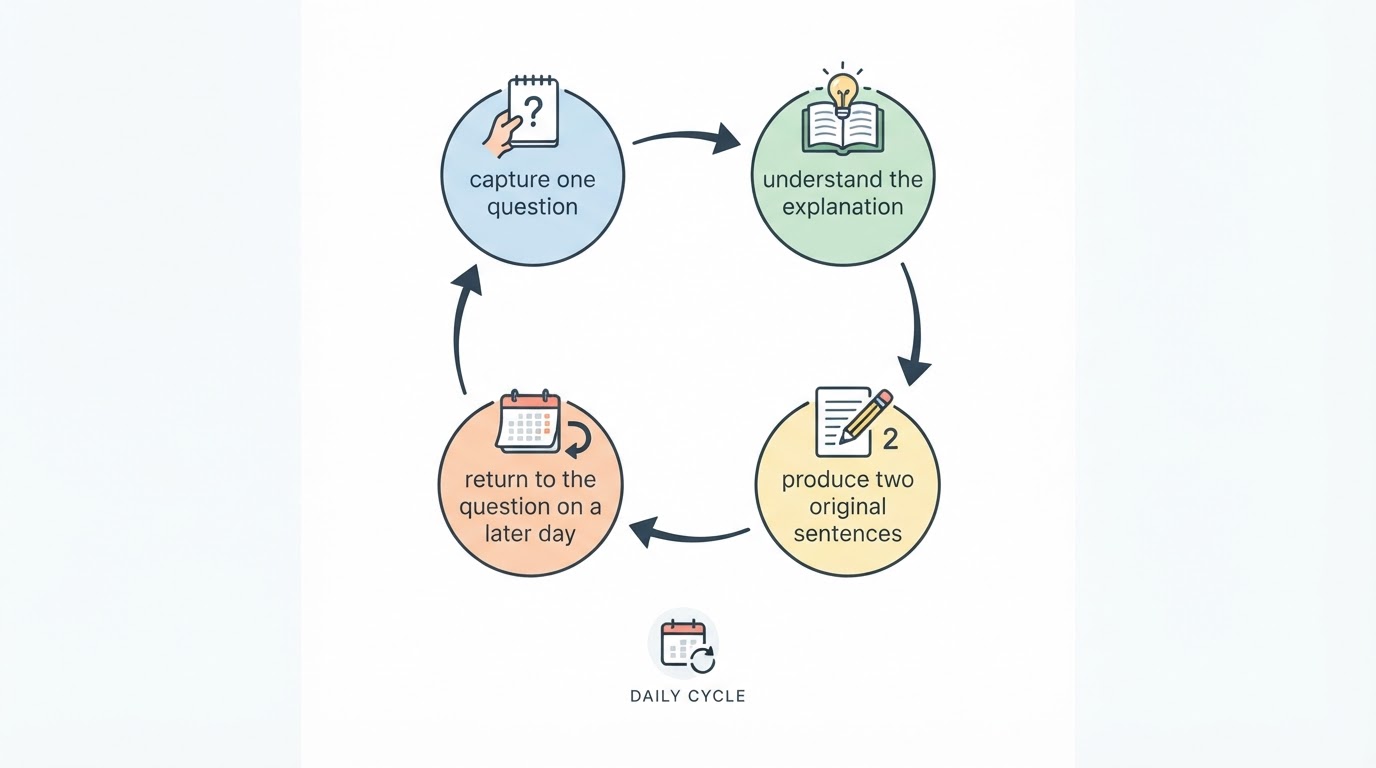
- Capture. Keep one running list of questions exactly as they appeared, in the sentence that caused them.
- Understand. Get the explanation once, then restate it in your own words in a single line.
- Produce. Write or say two new sentences that use the pattern, this time about your own life.
- Return. Open the same question three days later and answer it without help.
- Retire or repeat. Retire questions you can answer cold; repeat the rest in the next session.
A CEFR-style progression, from A1 through C2, gives this loop a useful frame. The levels describe what a learner can do, so they help you judge whether a question belongs to your current stage or to the next one. The routine stays the same; only the sentences get more demanding.
The loop also protects you from the most common failure, which is confusing understanding with ability. You understand an explanation in seconds. You own a pattern after producing it several times without help.
Common Mistakes and Honest Limitations
Watch for a few patterns:
- Asking vague questions. Asking why a sentence needs the past perfect instead of the simple past gets a stronger answer than asking why it is wrong.
- Collecting explanations. A folder of clear answers is not progress until you produce the sentences yourself.
- Skipping speaking. Silent study hides pronunciation and fluency problems, which are exactly the gaps a live attempt exposes.
- Expecting a study plan. An AI tutor answers questions; it usually does not sequence months of material for you.
- Accepting the first answer as final. If an explanation contradicts your course material, ask for the rule and an example, then check both against a trusted source.
The honest limitation is context. A tutor sees the sentence you paste, not the situation, the exam you are preparing for, or the way you spoke last week. Bring the context yourself and the answers improve sharply.
How to Judge Whether a Free AI Tutor Is Worth Using
Free tiers differ, so compare them on criteria rather than on promises. A short checklist:
- Does the free tier include the tutor, or only the lesson path?
- Are explanations on demand, or limited to a daily allowance?
- Does an answer explain the pattern, or only translate the sentence?
- Can you ask follow-up questions about the same sentence?
- Does the app connect the tutor to a structured course, so explanations reinforce what you are learning?
- Does speaking practice include feedback on recorded speech?
- Is the content available in the language pairs you actually need?
Score each item yes or no. A tool that handles three or four of them well is more valuable than one that promises everything and explains nothing. Price is easy to compare; usefulness is not, which is why the checklist matters more than the discount.
A Free Option Built Around On-Demand Explanations
One example of that pattern is MANA Learn, a free language learning app whose AI tutor is built around on-demand explanations. According to the product's own material, the tutor answers questions about vocabulary, sentence structure, and grammar in context, and it is described as available within lessons around the clock without an additional cost. The app's own product information states that the AI explanations are not locked behind a paid tier, so a learner can ask while the question is still alive.
That detail matters for the free-tier criteria above. An explanation that appears only after an upgrade does not help at the moment you are stuck. As always, judge it against your own list: bring a real question, ask it, and see whether the answer explains the pattern well enough for you to produce two sentences of your own.
FAQ
Is an AI tutor enough to learn a language on its own?
No. It is an explanation and feedback layer, not a curriculum. It works best on top of a course, a textbook, or regular conversation practice, where it can answer the questions that structure alone cannot.
Do AI tutors replace teachers?
They replace some reference lookups and some repetitive corrections. They do not replace the planning, accountability, and live interaction a teacher provides. The realistic picture is a supplement that makes the time between lessons more productive.
How long should a daily session be?
Three to five minutes is enough if the session closes one question. Consistency beats duration: a short block you complete five days a week will outgrow a long session you keep skipping.
What should I do if an AI tutor's explanation seems wrong?
Ask for the underlying rule and a second example, then compare both with your course material or a dictionary entry. If a pattern still looks inconsistent, note it and ask a teacher. Questions about a wrong answer usually teach more than the answer would have.
Does a free AI tutor mean lower quality?
Not automatically. Free can mean limits, a smaller course library, or fewer practice types. What matters is whether the explanations are available when you need them and whether they help you produce the language yourself. Compare the criteria, not the price tag.
Takeaway
An AI tutor is most useful as a small, fast loop: bring a real question, get an explanation that names the pattern, produce two sentences of your own, then return to the question a few days later. Keep the loop short and repeatable, judge tools by what they let you do for free, and treat every explanation as the start of practice rather than the end of it.