Start with the session, not the feature list
Most learners do not quit because an app lacks features. They quit because the features they need are buried inside a routine they never repeat. Before you compare catalogs, check what the app asks of you in the first five minutes of an ordinary weekday.
Start by auditing your own week, not the app store. Mark the moments when you have three to five minutes and one free hand: waiting for coffee, standing on a platform, between meetings. Those moments are your real study budget, and an app that cannot fit into them will not survive past the first busy week.

A busy professional who plans to study on the commute should test the commute build specifically: headphones in, screen barely touched, one short task completed. A student with a longer evening window can afford a heavier lesson, but the same rule applies. If the daily session does not finish cleanly, the habit ends as soon as life gets noisy.
The 3-5 minute session test
Short sessions work when they are self-contained. Each one should leave you with a small, specific result: a set of phrases you can now pronounce, a grammar pattern you recognize, or a short text you understand without translating every word.
Ask what a session gives you when it ends:
- One clear learning objective
- A speaking or writing attempt, not just recognition
- Immediate correction or a score you can act on
- A visible next step for tomorrow
If you cannot answer those four questions after a trial week, the session format is wrong for your schedule, however impressive the course catalog looks.
Listening, speaking, reading, and writing in one loop
Apps that cover all four skills keep them connected instead of treating them as separate modes. A short loop might look like this: listen to a sentence, repeat it aloud, read a variant, then write your own version. Because the same vocabulary returns in each step, the loop builds retention without adding study time.
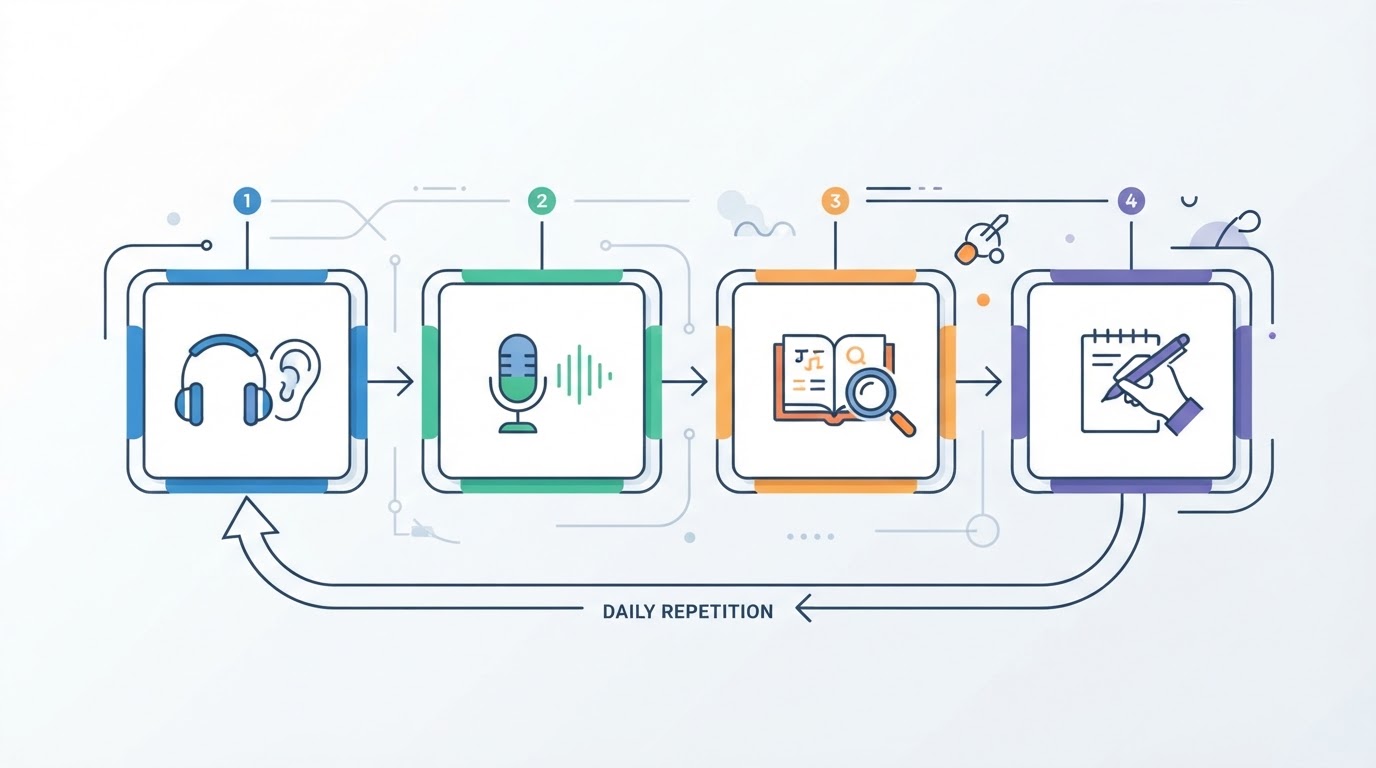
The trade-off is real: a five-minute loop cannot replace deeper practice such as extended conversation or long-form reading. It is a habit engine, not a substitute for immersion. Choose an app that makes the short session sustainable, and schedule longer practice separately when your goal requires it.
How to evaluate the AI features
"AI-powered" appears on almost every product page, and on its own it tells you very little. What matters is where the AI sits in the learning loop and what it does with your mistakes.
Look for feedback you can act on
Good feedback names the specific problem and shows a correction. "Incorrect" teaches nothing; an explanation that points to the ending or the word order gives you something to practice. When you test an app, deliberately make three mistakes and watch what happens: how specific the explanation is, whether you can retry immediately, and whether the mistake is stored for later review.
Match the AI to the skill you are training
Different skills need different feedback. Pronunciation practice needs a score plus a hint about which sound drifted. Grammar practice needs a corrected sentence and a short reason. Vocabulary needs context, not a bare translation. An app that applies one generic correct-or-incorrect response to every exercise is usually optimizing for speed rather than learning.
Check for CEFR alignment and visible progress
The Common European Framework of Reference (CEFR) describes language ability across six levels, from A1 (beginner) to C2 (proficient). An app mapped to CEFR levels gives you two practical benefits: you can describe your level to a teacher or employer, and you can tell whether the next course is genuinely harder or just different.
Look for a clear level path and a plain-language description of what each level covers. If progress is measured only in streaks, points, and badges, you may be tracking a habit rather than an ability.
Judge the free tier before you commit
Free tiers differ far more than paid ones. Before you subscribe, answer three questions:
- Which features work without payment, such as lessons, speaking practice, explanations, or only vocabulary review?
- Are there daily caps, ads, or energy limits that interrupt the routine you planned?
- Can you review or export your progress, or would leaving the app mean losing your history?
Free-tier value is not about getting everything for nothing. It is about whether the unpaid version can support a daily routine long enough to prove the app works for you. An app that keeps its full feedback loop usable on the free tier is usually a safer first trial than one whose useful features appear only after payment.
A daily routine you can copy
This template fits a three-to-five-minute session and works with most structured apps. Adjust the timing to your own window, but keep the order: input first, output second, feedback last.
Time | Step | What you do | What good looks like |
|---|---|---|---|
0:00-1:00 | Warm-up | Review yesterday's mistakes | The app resurfaces items you got wrong, not random new words |
1:00-2:30 | Input | Listen to and read one short lesson | One objective, explained in plain language |
2:30-4:00 | Output | Repeat aloud, then write one sentence | Immediate feedback on pronunciation or structure |
4:00-5:00 | Close | Note one thing to fix tomorrow | The next session picks up that mistake |
If five minutes is all you have, do the warm-up and the output step, and skip the rest. Producing one spoken sentence is worth more than skimming three unfinished lessons; the input step can wait for a longer window.
Common mistakes and trade-offs
- Optimizing for streaks instead of skill. A streak proves you opened the app, not that you can use the language. Track whether you can complete a task you could not do last month.
- Choosing breadth over one routine. Five apps with half-finished courses teach less than one app used daily for a month.
- Skipping the output step. Recognizing a word when you see it is easier than producing it from memory. Speaking and writing are where short sessions earn their value.
- Expecting AI to replace a teacher. AI feedback is fast and always available, but it can be shallow on register, nuance, and cultural context. Keep human feedback for the moments that matter, such as interview preparation or exam writing.
- Reading the free-tier limits in week three. Check the plan limits before you build the habit; a routine that breaks after seven days undoes more progress than a smaller routine that continues.
How MANA Learn fits this framework
MANA Learn is a free AI language learning app that matches several of the criteria above, and it is one useful example of what to look for. Its structured courses follow the Common European Framework of Reference from A1 to C2 and cover listening, speaking, reading, and writing across multiple language pairs, including Chinese-English and Japanese-English. The platform states that it uses AI to adapt lesson sequencing based on how a learner progresses through the levels instead of holding everyone to one fixed order.
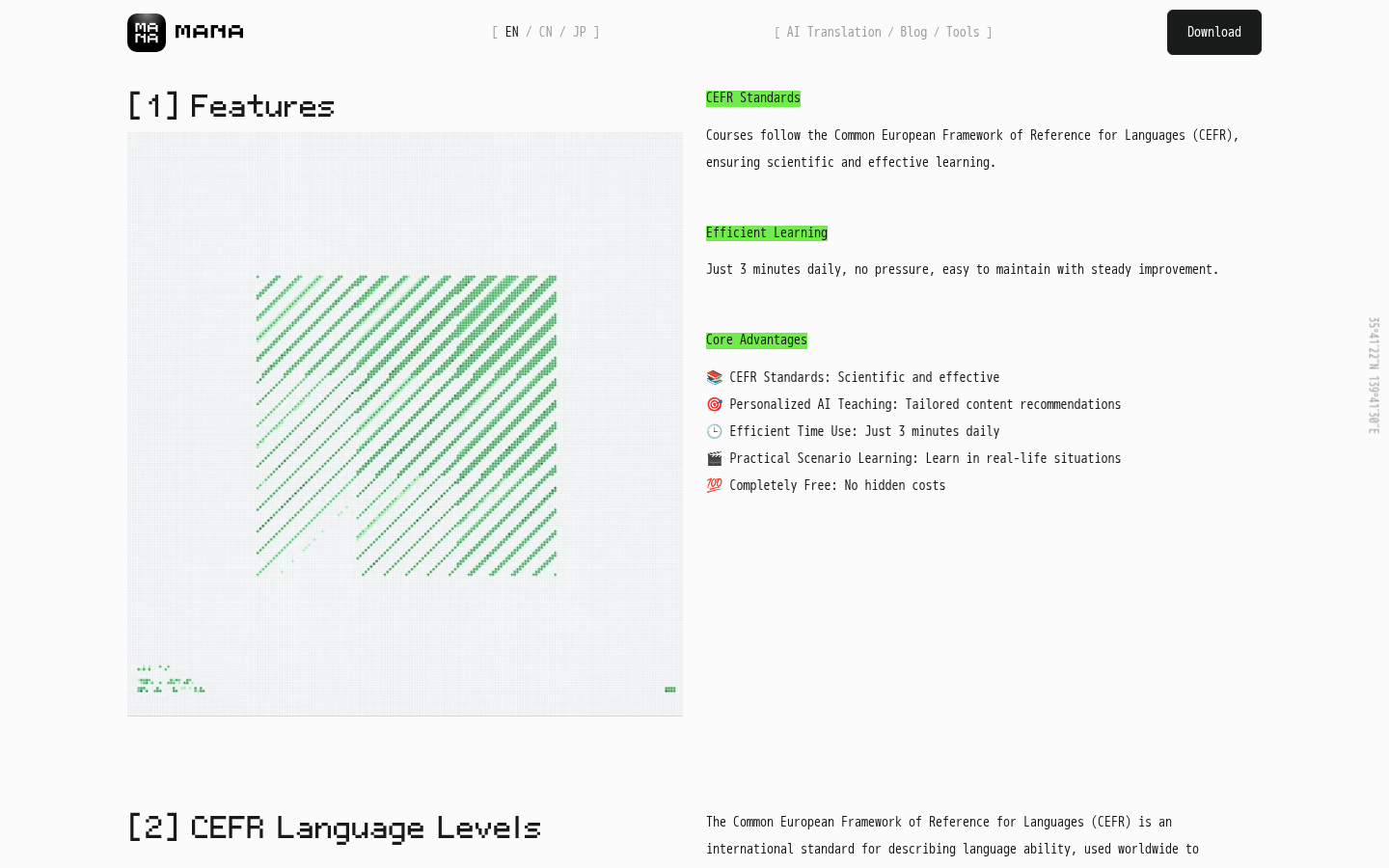
Felo product screenshot.
Judged against the criteria in this guide, that combination covers both the level path and the four-skill loop in one place. Whether it fits your routine still depends on the same tests every app faces: the languages you need, what the free tier includes, and whether the sessions survive your actual week. Treat it as one candidate to trial alongside others, not as a default answer for every learner.
FAQ
How long should a daily session be?
Three to five minutes is enough to maintain a habit, review yesterday's mistakes, and complete one small input-output loop. If your goal is fluency for work or exams, add longer reading, listening, and speaking practice outside the app; the short session is the floor, not the ceiling.
Do I need a paid plan to get useful AI feedback?
Not necessarily, but it varies by app. Check whether explanations, speaking practice, and mistake review work on the free tier before you pay. If the feedback you need sits behind payment, a different app may serve your routine better.
Is CEFR alignment worth prioritizing?
It is if you want your progress to mean something outside the app. A CEFR-mapped path from A1 to C2 makes levels comparable and helps you choose material that matches your ability. Apps without a framework can still help, but you will need another way to measure progress.
Can short daily sessions really teach a language?
They build vocabulary, pronunciation habits, and grammar recognition steadily, but they cannot deliver conversation fluency or advanced writing on their own. Use the short session as your daily floor and add longer practice whenever your goals require it.
The takeaway
Choose language learning apps the way you would choose a training plan: by the sessions you will actually complete, the feedback you can act on, and the progress you can verify. Start with a free tier that keeps the full loop available, follow a structured level path such as CEFR, and review your mistakes every day. If a three-to-five-minute session covers listening, speaking, reading, and writing with instant feedback, you have found a routine worth keeping, whether you use MANA Learn or another app that clears the same bar.